Monday, March 3, 2014

Top Ten Genealogical Pick-Up Lines

someecards.com - Let's you and me get together and read Evidence Explained some time.
10. Is that a wand scanner in your pocket or are you just happy to see me?

9. Let's you and me get together and read Evidence Explained some time.

8. So, will I see you at Jamboree?

7. Did it hurt when you fell out of that family tree?

6. I bet we have lots in common, including some ancestors.

5. I'd like to add you to my family tree.

4. I'd like to marry you and label all of our wedding pictures well for the benefit of future generations!

3. I see the perfect spot for me next to you on your pedigree chart.

2. Let's go get our DNA tested to make sure we're not related in a genealogically significant time frame.

1. What's a nice girl like you doing at a genealogy conference like this?


Use the comments section to add to the list!

Monday, February 24, 2014

Location, Location, Location

I have the great fortune of living in New York City as I research my ancestors in New York City. Not everyone can live where they research, but I highly recommend it.

It's nice to have the kind regular, incidental interactions with the lives of my ancestors that occurs when you live in close geographical proximity. I attend church at the parish where my 2x great-aunt was a member. I've been known to point out to friends, on our way home from an evening out, "That's where my grandparents were married." And just last week, when reminding myself of the neighborhood where my grandmother grew up for a note in this post, I remembered that my grandmother, Marilyn Mulcahy, had been baptized at St. Anselm's Church in Bay Ridge.

Baptism of Marilyn Mulcahy, 11 March 1931

This sounded a little familiar, and it didn't take me long to realize that I was there, last summer, when my friends' son was baptized. At the time, I had no idea that the church should hold any particular significance for my family, so it's a bit of a missed opportunity, but also one of those small moments of serendipity that connect me to my ancestors through time - whether I realize it or not.

It also, luckily, means I'm just an e-mail away from having a photograph of the church where my grandmother was christened. 

The happy parents with baby Jamie at St. Anselm's
Godmother April, parents Jeff and Michelle, and me holding Jamie
Photos courtesy of Michelle's dad.

Friday, February 21, 2014

Submit your Stories!

Some of the greatest experiences I've had in my genealogical research involve serendipity, those almost mystical moments when an ancestor makes it clear he wants to be found, or when generations collide with a kind of synergy.

There were two moments when this serendipity has been most obvious in my own research:

When my cousin visited the Brooklyn Historical Society and discovered that the person who had signed the sign-in sheet earlier that evening had given her home address as exactly the house we were researching. This netted us a fantastic trip to and tour of the old family homestead.

When I learned my great-grandmother's full given name and discovered that my dad had managed to name a daughter after his grandmother, like he wanted to, without realizing it until she was 21 years old. 

I know I'm not alone in having these magical, sometimes chilling experiences.  And so I'd like to invite you, my readers, to submit your favorite stories of genealogical serendipity, to be shared (with permission and attribution) in the series I plan to run this Spring. You can submit stories in the comments or via e-mail (kathleen.scarlett.ohara AT gmail.com). Please include a link to your blog, if you have one. (If you're interested in writing a full-fledged guest post about your serendipitous experience, let me know and we can talk about it.)

Monday, February 17, 2014

Photography, Past, Present, and Future

Were the past 50 years a photographic blip?

I have 1 photograph of my great-grandfather as a child. I've seen maybe a dozen pictures of my grandmother as a child. There are several photo albums full of hundreds of pictures of my dad as a child. There are probably thousands of photographs of me as a child.

I've seen dozens of photographs of my great-grandfather as an adult. Hundreds of photographs of my grandmother as an adult. Hundreds of photographs of my dad as an adult. A handful of photographs of me as an adult.

When I say "photographs," I'm talking about physical, hard copy photographs. The kind of thing that will last through the fast-moving, planned obsolescence of modern technology. My great-grandfather's life saw the gradual transition from occasional, complicated, special-event, professional photography to inexpensive, omnipresent, personal photography, and the attendant increase in pictures. My life saw the transition from inexpensive, omnipresent, personal film photography to inexpensive, more-than-omnipresent personal digital photography, and the attendant decrease in physical photographs.

It's not like there aren't any photographs of Joseph Mulcahy as a child. There's this one. And it's not like there aren't any pictures of me as an adult.  There are 7 framed photographs of me in my apartment. 6 are from my wedding day. (The 7th is from a friend's wedding.) Plus, we have a few photo albums. At the end of 2011, I made a point of having prints made of good, representative pictures from the year, which might have been a dozen pictures or so. I haven't yet done the same for 2012 or 2013. I did have prints made of our honeymoon to St. Lucia, and made up a photo book of pictures from our recent trip to Ireland.

In other words, if you look past my unusual conscientiousness in 2011, the physical photographs of me and my husband as adults represent almost exclusively special occasions. Kind of like the extant photographs from c. 1900, right?

I firmly believe that in 100 years, the digital photographs that currently overload our hard drives and are posted to the internet ad nauseum will not have survived. Many photographs on paper won't have, either, but they've got a better chance. Our descendants will find themselves looking at a handful of special-occasion photographs from the late 19th and early 20th centuries; an unmanageable glut of unlabeled photographs from the mid and late 20th century; and a handful of special-occasion photographs from the 21st century and beyond.

Monday, February 10, 2014

Book Review: Someone by Alice McDermott

I recently joined a local book club through Meetup.com, and the first book I was able to join them for was Someone by Alice McDermott. I didn't read the book because it was historical fiction about Brooklyn; I read it because I've been trying to "officially" join this book club for months now, and this was the book they chose during the month I could make it to a meeting. I was excited to discover, though, that it was the story of a girl growing up in Brooklyn during the interwar period.

That much I got from the description on the back of the book. As I started reading, though, I began to realize that the main character, Marie, was growing up in Carroll Gardens, or South Brooklyn, as it might have been known at the time. She even attended St. Mary Star of the Sea Catholic Church, which was where my Madigan and Mulcahy families would have gone to church when they were living at 85 Luqueer Street! I enjoyed this aspect of the book, even though my direct ancestors were no longer living in the neighborhood at the time the story is set. (Marie would have been more or less a contemporary of my grandparents, but my grandfather grew up in Park Slope and my grandmother, whose parents were from South Brooklyn, grew up in Bay Ridge and Flatbush.)

Given the amount of time I spend researching in Brooklyn, I always appreciate a book that gives me a flavor of the borough in general, or the culture of neighborhoods like Carroll Gardens in particular, and Someone did this in excellent fashion. I think anyone who is interested in this era of Brooklyn history would find this an interesting glimpse at the time and the culture, though it's obviously not a history book or a scholarly tome.

The book was, luckily, equally enjoyable as a work of literature. The narrative of the book switches from Marie's childhood to various stages of her adulthood, and while this is not what my linear brain would have preferred, it worked well and wasn't difficult to follow. My book club had some great discussions about the relationship between Marie and her brother Gabe and the dichotomy they represented, but I was also glad that as they grew, the author added some nuance to the depiction of them as polar opposites when they were young. If I had to describe it in a sentence, I'd say that the book is primarily about familial relationships and the way a person - and a family - can grow and change over a lifetime. It's a really good read, and while some of the book club members thought it was hard to get into, I found it impossible to put down from the very beginning. I recommend it highly!

Disclosure: This post contains Amazon.com affiliate links. This means that if you choose to make a purchase from Amazon after clicking one of these links, I will receive a small portion of your purchase price as a commission. I personally make a point of starting my Amazon shopping through the affiliate links of bloggers and friends whenever possible, so that large corporations are not the only beneficiaries of my purchases, and encourage others to do the same, regardless of whether they use my affiliate links or another blogger's.

Monday, February 3, 2014

Joseph E. Mulcahy's WWI Service Records

I recently ordered the NYS WWI Service Records of all 4 of my great-grandfathers. This will be my next foray into trying to interpret service records, as I attempt to do genealogical research in military records. The military service record for one of my paternal great-grandfathers, Joseph Eugene Mulcahy, consisted of two cards, each pictured here (front and back).


The biographical information in this record substantiates what I already knew. Joseph E. Mulcahy was born 3 September 1896, and lived at 85 Luqueer Street in Brooklyn. According to the record, he enlisted at Fort Slocum, NY on May 9, 1917. I've never been able to find a WWI draft card for Joseph Mulcahy; instead, I have an article from the Brooklyn Daily Standard Union, dated 28 June 1917, describing how he and his brothers enlisted after their father's death.

28 June 1918
This has always lead me to assume that they did not need to register for the draft because they enlisted instead. The Navy Service Record that I received for my other paternal great-grandfather, John O'Hara, has led me to reconsider whether this is accurate, since he seemed to both sign up for the Navy and enlist.

The service record goes on to record Joseph's promotions through the ranks. He was promoted to Corporal on 19 Aug 1917, and to Sergeant on 19 April 1918. The first card says that he accepted a commission on 4 June 1918; the next card says that he was appointed 2nd Lieutenant on 5 June 1918. (Would these two events not have been simultaneous?)

I also received from a cousin a scanned copy of Joseph's promotion to 2nd Lieutenant, which is dated 1 June 1918.

Suffice it to say, by the end of the first week of June, he was a 2nd Lieutenant. At my present level of knowledge, I can't be more precise than that.

Joseph E. Mulcahy's "principal stations" were at Camp Gordon, GA; Camp MacArthur, TX; and Camp Johnston, FL. He received an honorable discharge on 3 Dec 1918, approximately 6 months after receiving his commission, and without ever having been involved in any engagements or even served overseas.

Monday, January 27, 2014

Mother Malone: Family History through Song

When it comes to music, the two sides of my family couldn't be more different.

On the maternal side, I have a hearing-impaired grandfather who nonetheless taught himself to play the piano by ear; a songwriter for an uncle; and an up-and-coming singer for a cousin.

On the paternal side, I had a tone-deaf grandfather; a father who can't sing; and, well, that's about all that's worth mentioning.

And yet, when I conceived of a blog post talking about music and family history, it was the latter family I was thinking about. (Possibly this is because my musical skills are quite clearly inherited from the from the family that has none.)

Some of my most cherished childhood memories are of my dad singing lullabies to my sister and I each night before bed, and it's through these memories that I find some of the strongest connections to my grandmother, who died when I was too young to remember her well.

My dad's repertoire included standard lullabies, like "Hush, Little Baby." Other songs were show tunes. (I clearly remember that the visual I had for the line "Bet your bottom dollar that tomorrow there'll be sun" involved someone with a large stack of money, betting only the bill at the very bottom.) Some were hymns, "Amazing Grace" being a favorite in honor of my sister's middle name. And then there's the song that sticks in my mind most clearly: "Mother Malone."

When I try to look this song up on the internet, every set of lyrics is slightly different, and none exactly match the version my dad sang to me, which his mother had sung to him, and which I will sing to my kids. Additionally, the melody in recordings I've found is a bit different from the one I know. I guess that's part of the beauty of a folk song: it's passed on through the generations. Maybe, sort of like DNA, it mutates a bit along the way, creating a unique signature that can identify your family. The version of the song that I learned growing up went like this:
Some boys when they go a-courtin'
They haven't the spunk of a mouse
They'll stand on the corner and whistle
Afraid to go into the house
But me I walk in with me swagger
As if the old place were me own
And I sit myself down with "Good evenin'"
"How are you, old Mother Malone?"
Then I kiss the old woman
And hug the old man
Give Johnny a shilling and shake hands with Dan
Fight for his sister
And do all I can
Do all I can
Then I walk out with me girl Mary-Ann

Have you ever discovered that a song - or a version of a song - is unique to your family? Where did it come from? How have you passed it on?


Disclosure: This post contains Amazon.com affiliate links. This means that if you choose to make a purchase from Amazon after clicking one of these links, I will receive a small portion of your purchase price as a commission. I personally make a point of starting my Amazon shopping through the affiliate links of bloggers and friends whenever possible, so that large corporations are not the only beneficiaries of my purchases, and encourage others to do the same, regardless of whether they use my affiliate links or another blogger's. Of course, since the links above are to my family's music, I encourage you even more strongly to support their efforts, and can guarantee that you won't be disappointed in your purchases!

Monday, January 20, 2014

John Joseph O'Hara's WWI Service Record and a Plea for Help

Although WWI Navy records were supposed to have fared better than Army and Air Force records in the 1973 fire at the National Personnel Records Center, I still received no results when I requested a search for my great-grandfather John O'Hara, despite his Navy service. (This was probably due at least in part to the fact that I couldn't include his Social Security Number on the request, as I just can't find him in the SSDI, no matter how hard I search, and despite knowing when he died.)

For whatever reason, not being able to get records I thought would be available led me to research alternatives - which I had never done to try to find the Army records I knew probably weren't available for my other 3 great-grandfathers. I discovered that the NYS Archives holds state-level versions of military service records - and for the low, low, price of just $1!

I figured I could splurge enough to spend $4 and order the records for all four great-grandfathers at once, which I promptly did.

WWI Service of John J. O'Hara
World War I, Navy, 303 Vanderbilt
WWI Military Service Record of John J. O'Hara, NYS Archives

According to this service record, John J. O'Hara enrolled at the Navy Recruiting Station on 4 June 1918.

World War I, 303 Vanderbilt, Anaconda Copper Company
WWI Draft Registration Card for John J. O'Hara, Ancestry.com
According to his draft registration card, obtained from Ancestry.com, he registered for the draft on 5 June 1918 at Local Board No. 45 at the YMCA at 55 Hanson Pl.

Something seems funny here. He registered for the draft the day after he enrolled in the Navy? My husband and I started coming up with theories:
"Maybe when he enrolled he was told he needed to be registered for the draft, so he went home and did that the next day?"
"Maybe he knew he was going to have to register for the draft, and wanted to sign up first to make sure he ended up in his preferred branch (the Navy)?"
However, the fact is that neither of us knows enough about military history or the rules and regulations of wartime conscription to know whether we were making any sense. (I first wrote this post using "enlisted" as a synonym for "enrolled," assuming they meant the same thing. Then I noticed that both were options on the service record, and "enlisted" was crossed out. If "enrolled" doesn't mean "enlisted," what does it mean?)

Beyond that, the service record doesn't provide much information about John O'Hara's military career. It seems that he spent the entirety of it in the Naval Training Camp at Pelham Bay Park in the Bronx - at least, that's the only place that's mentioned. However, the dates of service and the number of days served don't match up exactly, so I can't help but wonder if something is missing or incorrect. Based on the 4 service records I received, only 1 of my 4 great-grandfathers (not this one) served overseas during WWI, though all served in the military.

Plea for Help
Needless to say, that this is an area in which I have very little knowledge is severely hampering my interpretation of this document. (I understand the Army service records I received for the other 3 great-grandfather better . . . or else so poorly that I don't know what I don't know!) I've run into this problem before, when I realized I didn't know how to interpret a Civil War Service Record well enough to figure out whether it belonged to my 3x great-grandfather. That question is still just as open as it was in 2009, because I still don't know how to interpret a Civil War Service Record, or where to find out how to interpret a Civil War Service Record.

So here's my plea for help: What resources are available to help me learn to interpret these and other military records? I can find the records, but I'm not doing anything more than accumulating papers if I can't understand them. Are there websites that focus on this type of thing, blogs run by experts in military history, books I should be reading, or a guy your cousin knows who's made interpreting service records his life's goal? Please tell me in the comments! (And if you're someone who knows about this stuff, an "explaining and interpreting military history" genealogy blog might really fill a niche!)

Monday, January 13, 2014

Tutorial: Searching Fulton History

One of the most significant online resources for research in New York State is the website FultonHistory.com. It has dozens of out-of-copyright NYS newspapers, all scanned, OCR-searchable, and available online for free. The site's owner, Thomas Tryniski, has undertaken this entire project by himself, and does not, as far as I'm aware, receive any monetary gain as a result - just the undying love and appreciation of every genealogist who's ever attempted to research in New York State.

(Don't be misled - although the site focuses on New York papers, just in doing test searches for this post, I came across results from newspapers in Massachusetts, Pennsylvania, Canada, and Mexico; it's worth at least a glance, no matter where your research is focused!)

My research wouldn't be the same without Fulton History, but I've heard over and over again - from cousins researching our joint lines as well as from fellow genealogists on list servs, in comment boxes, and elsewhere - that they don't utilize the site because they just can't figure it out, or they don't know how the search function works, or their searches return thousands of results and can't be narrowed down.

Now, any OCR (Optical Character Recognition) searchable database is at the mercy of the quality of the images, and my understanding is that what Fulton History has access to tends to be second- and third-generation library copies of the microfilmed newspapers, so the images - and, as a result, the search function - are not necessarily the highest quality. However, when you know what you're doing, searching Fulton History is actually quite easy, and it's 100% worth it to take the time to learn. It will absolutely revolutionize your research.

As a result, I've put together this tutorial, in hopes that it will convince some people to take another look at Fulton History. (And also so that I have something to link to, rather than typing out directions every time the subject comes up on the Brooklyn list!)

Step 1: The Goldfish
On the first screen, you'll meet the swimming goldfish, the first of several utterly unusual but charming elements of this site. Although the site's title is technically Old Fulton Post Cards, the vast majority of the content is newspapers, not postcards. Click "Enter" to get to the search page.

Fulton History

Step 2: The FAQ
I'm writing up my tutorial here, but I strongly suggest reading the FAQ. Once you've reached the search page, click on the "FAQ_HELP_INDEX" button at the top right. It's worth it to get an idea of the different search strategies that Tryniski built into the site, not all of which are ones I will cover here.
fultonhistory

Step 3: The Index
For our searching purposes, it will be vital to know which of the newspapers on the site you're interested in searching. The index is not necessarily easy to find, but there is a link to it in the first lines of the FAQ, so it's good to visit while you're already in the FAQ thanks to Step 2.

old fulton post cards

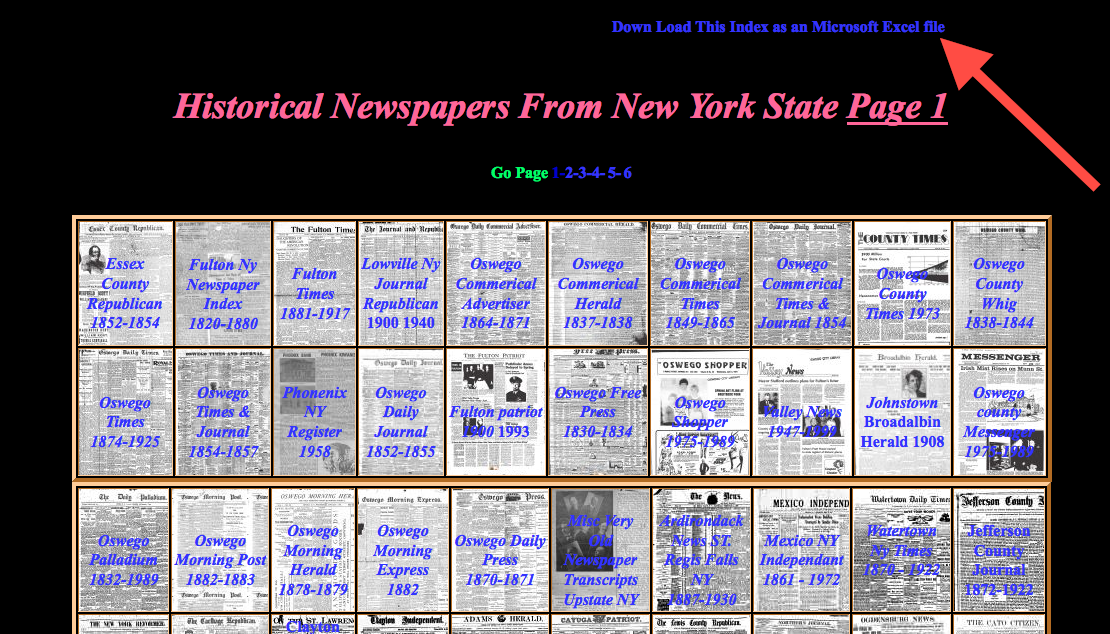
It's also not particularly user-friendly, so I highly recommend downloading the Excel file to your computer, which is much easier to handle. There is a link to do so at the top right of the page:

fulton history historical newspapers index

Once you're looking at the Excel file, you can use CRTL+F (or COMMAND+F, if you're on a Mac) to search for the titles of newspapers you're interested in, as well as to find out what other papers exist for the areas you're researching. The index includes the county in which each paper was published, so searching for the county of interest is a good way to find out what newspapers might have been published nearby. If I search for "Kings" County (aka Brooklyn), I get a number of results that are actually for Kingston, so I'll search for Brooklyn instead - luckily, all of the references to Kings County are followed by "(Brooklyn)," although that's only the case for boroughs of NYC. I get the following results:
  • Brooklyn NY Daily Eagle 1841-1955
  • Brooklyn NY Daily Star 1898-1933
  • Brooklyn NY Daily Union Argus 1877-1883
  • Brooklyn NY Daily Union 1870-1887
  • Brooklyn NY Standard Union 1888-1932
  • Brooklyn NY Union 1883-1886
  • Brooklyn NY Weekly People 1901-1973
You can compile a similar list for any county you're interested in. Be sure to note them exactly as they appear. If you happen to be interested in Brooklyn - or any other borough of NYC - it is also a good idea to look into some New York City (aka Manhattan) papers, too. Even in the pre-1898 days - the days before Brooklyn, Queens, and Staten Island joined New York City - I had Brooklyn families who showed up primarily in New York City papers, as well as Brooklyn families whose newsworthy stories appeared in both Brooklyn and Manhattan papers, oftentimes with different details in each. Get an idea of what newspapers you'll want to search. It won't be exhaustive, and there are search techniques for which you won't need to specify a title, but it's a good place to start.

Step 4: Search using Boolean techniques
The single most useful technique for mining Fulton History website is the Boolean search. Especially if you are looking for an individual with a common name, you need to be able to narrow down your search results so you don't end up with many thousands of results. There are several ways to do this. Regardless of which you plan to use, begin by selecting the "boolean" option from the drop-down menu on the search page.

fultonhistory search

Now, you have to format your search as a Boolean search. Most basically, this means that words like "and," "or," and "and not" function as operators, rather than search terms. The Boolean search function at Fulton History will search for the terns you enter exactly. Enter your terms; if there is more than one, connect them with one of the above operators. Most often, you'll be using "and," but "or" or "and not" are good to have in your arsenal for when your searches need to be a little more nuanced.

For example, you could search for any of the following terms:
  • Michael Mulcahy [returns any page that has the phrase "Michael Mulcahy"]
  • Michael AND Mulcahy [returns any page that has both the word "Michael" and the word "Mulcahy," even if they are nowhere near each other]
  • Michael OR Mulcahy [returns any page that has either word, including all appearances of "Michael" anywhere in the database]
  • Mulcahy AND NOT Michael [returns any page that has the word "Mulcahy" but not "Michael," which is useful if Michael Mulcahy is not your ancestor but a prominent individual who keeps popping up and clogging your results for your other Mulcahys]
Step 4a: Narrow your search
However, any of these could return many hundreds or thousands of results. It's necessary to be able to narrow your search by where your ancestor lived. One nice tip for doing this is using an ancestor's street address as one of your search terms. In the above case, this might mean searching for
Michael Mulcahy AND 85 Luqueer
However, frequently you don't know the ancestor's address, or want to cast a wide-enough net to catch articles that don't include the subject's address. The best way to narrow your search so that you're not finding every Michael Mulcahy in New York State (and beyond) is to search the specific newspapers relevant to the place where your ancestor lived. Return to the list you created in Step 3. In order to search a specific newspaper, you have to use the exact title of that paper as one of your search terms. (For now, do not include any years in the title.) For example, to search the Brooklyn Daily Star for Michael Mulcahy, you can use the string
Brooklyn NY Daily Star AND Michael Mulcahy
You can also narrow your search by time frame, though I've found that this really only works well when you are searching by newspaper title as well. Just add YEAR~~YEAR to the end of the newspaper title you are searching, indicating the beginning and ending years of your time frame. Since my Michael Mulcahy died in 1917, I might use 1917 through 1918 to check for an obituary and probate notice, using the following string
Brooklyn NY Daily Star 1917~~1918 AND Michael Mulcahy
Step 4b: Widen your search 
A search like that won't always be comprehensive enough to return all the articles about your ancestor, though. Sometimes it is necessary to both narrow and widen your search at the same time - essentially, to be very precise. Fulton History offers several ways to widen your search, including "Fuzzy search" and "Phonic search," but I won't cover these, as they're not among the functions I find most helpful. In my opinion, the most useful way to widen your search is to search for words within a certain distance of each other. There are lots of situations in which this is helpful. Some might include
  • If your ancestor might be mentioned with or without a middle initial
  • To find a death notice in the form of "LASTNAME - On [date], FIRSTNAME, [spouse] of . . ."
  • To find relatives or associates mentioned in proximity to each other (e.g. as survivors in a death announcement, or guests at a wedding)
To search for terms found in proximity to each other, use the operator w/x, where x is the number of words within which you want to search. To find a Michael Mulcahy who may or may not be listed with a middle name or initial, use
Michael w/1 Mulcahy
You can combine this with the above strategy of search certain newspapers like so
Brooklyn NY Daily Star AND Michael w/1 Mulcahy
Michael's son Joseph was a police captain, who might alternately be mentioned as Capt. Mulcahy, Capt. Joseph Mulcahy, or Capt. Joseph E. Mulcahy. For a search that would find any of this references, use
Capt w/3 Mulcahy
As it happens, this returns over 100 results, for police and military captains throughout New York and North America. Again, here you have to combine the strategy of widening your search with that or narrowing your search, by choosing specific Brooklyn or New York City papers and searching each of them in turn.
Brooklyn NY Daily Eagle AND Capt w/3 Mulcahy
Brooklyn NY Daily Star AND Capt w/3 Mulcahy
Brooklyn NY Standard Union AND Capt w/3 Mulcahy
Brooklyn NY Weekly People AND Capt w/3 Mulcahy
It's up to you to decide how wide you want your parameters to be. If the name is not too common, I sometimes search to find terms within 10 or 20 words of each other, hopefully close enough to eliminate coincidental appearances in unrelated articles on the page while also being broad enough to capture appearances at the end of a wedding announcement or brief obituary. Quite frankly, I've seen enough death notices that read something along the lines of
JONES - At home, in the eighty-sixth year of his age, BOB, beloved husband of Mary. . .
to know that neither Mary w/3 Jones nor Bob w/3 Jones will pick up that item. If you're searching for common names, however, a search distance of 10 or 20 could return nearly infinite results.

By combining the strategies described above, I have found Fulton History to be an extraordinary resource. Although it might sound complicated, the searching will begin to seem more and more intuitive as you use it more often - and with the wealth of information offered by the newspapers at Fulton History, you can't afford not to use it often!

Please, let me know if in the comments if you have any questions, or if you can add any techniques to help other researchers delve into the Fulton History databases!


If you appreciate what Fulton History provides, please consider making a donation to support the site. 

Monday, January 6, 2014

A visit to Turlough, Co. Mayo

Our last family history stop was the graveyard in Turlough, Co. Mayo. According to the 1929 obituary of my 3x great-grandfather, Martin Gillan, both he and his brother were buried there.
"With regret we record the death of above esteemed gentleman, which took place at his residence, Tawnykinaffe, on 30th January, at the ripe old age of 104 years. Deceased, notwithstanding his great age, was hale and hearty up to the time of his death, and was the possessor of a wonderful memory. It was a treat to listen to him recite legends which he heard from his father of the Irish rebellion of 1798, at which his father and two or three of his uncles joined the French forces to strike a blow for Irish freedom. He would also thrill you with tales of black ’47 (the year of the famine), when he was then a young man of 22. Hundreds of the people around his native place, and whom he knew well, died from starvation by the roadside, and in several cases were buried where they fell, there not being even a shroud or coffin to cover them. This was a time when disease and starvation were rampant in our country. But, as a lover of his native land, and its ancient language, he would tell of Castlebar a hundred years ago, which it was then a stronghold of the British and their sympathizers, and the change that has been wrought to-day, when there is not a vestige of the foreigner left. He was an ardent Catholic and died fortified by the consolations of our holy religion. His funeral took place to Turlough burial ground on Friday last, and his remains were laid to rest beside that of his late brother Thomas Gillen, Thomas Street, Castlebar, who also attained the great age of 99 years, and beneath the shadows of the ancient round tower. [emphasis added] The chief mourners were: Michael Gillen (son); Mrs. O’Donnell (daughter); Mrs. Gillen (daughter-in-law); Michael Gillen, Bridgie Gillen, Terrence O’Donnell (grand-children); Mrs. F. Chambers, Castlebar; Mrs. J. Hopkins, Crimlin; and Mrs. T. Staunton, Tawnykinaffe (nieces). The funeral was large and very representative, Rev. Fr. Neary, P.P., Parke, officiating at the graveside."
When we met my Gillan cousins, they were able to tell me that more recent generations had been buried in the cemetery, but couldn't verify that the first (known) Martin Gillan was there, too. Regardless, we took the trip out there on our last day in County Mayo, the day before our flight home. We got a smidge lost on the way, but were able to ask a nice couple for directions and discovered we were actually very close.

The graveyard itself is unmistakeable, thanks to the presence of the "ancient round tower."
It's not small, and my husband and I split up to cover more ground. We came across several relevant family names, but most were very recent burials, and our extensive searching did not turn up any of the older Gillan graves.

Turlough Burial Ground, Turlough Round Tower

Turlough Burial Ground, Turlough Round Tower

Turlough Burial Ground, Turlough Round Tower
 
The graveyard was not overgrown, but was apparently one of those places that only gets mowed a couple of times per year - and it had been a few months. It was a bit of an adventure, with uneven ground and damp, ankle-deep grass, but it was a gorgeous day and we enjoyed a pleasant hour or two looking at each stone.

Turlough burial ground, Turlough cemetery

Turlough burial ground, Turlough cemetery
Ben in the Turlough Cemetery
 It was only after that, as we were leaving, that we noticed the sign on the fence that had a history as well as an index of all the graves that had been legible as of the Irish Graveyards Survey several years earlier. 

Turlough burial ground, Turlough cemetery

Turlough burial ground, Turlough cemetery, Irish Graveyard Survey

Monday, December 30, 2013

2014 Family History Goals

I didn't do a full-fledged "goals" post at the beginning of 2013. Using the still-undone of my 2011 goals as a starting point, I'm going to pose some questions that I want to try to answer in the coming year. For a variety of reasons, I expect this to be harder to accomplish in 2014 than in years past, but I hope to make at least a little headway.
  1. Who were Mathew Madigan's parents? Who were Margaret Sullivan Madigan's parents?
  2. Who built the house at 85 Luqueer Street?
  3. What happened to Mary Mulvany, daughter of James Mulvany and Bridget Rothwell?
  4. Where was Maria D'Ingeo Gatto born, Italy or Brazil?
  5. Who were Hugh Quinn's parents? 
  6. What were the relationships between James and John Mulvany and between their wives, Bridget and Ann Rothwell?
Additionally, I'd like to:
  1. Commit to a schedule of 1 blog post per week
  2. Correct my apparent errors in the King family line
  3. Get back in the habit of visiting my local Family History Center
  4. Track down a photograph of each of my 2x great-grandparents (I'm currently at 5 out of 16)

As of this writing, the question that occupies most of my mental space is that of Maria D'Ingeo Gatto. At various times over the past year or two, it has been the Rothwell-Mulvany conundrum, or the old family homestead at 85 Luquer St. I have not systematically investigated any of the other questions, but they are all mysteries to some degree - or at least interesting questions - and all things I would like to find answers to.


Here's to a 2014 full of accessible records, online indexes, background reading, archival trips, focused research, serendipity, cousin bait, and genealogical happy dances!

Wednesday, December 25, 2013

The genealogy of Christ: He is conceived and born of a Vigin

In celebration of Christmas, I reproduce again the beginning of the first chapter of the Gospel according to Matthew.

The book of the generation of Jesus Christ, the son of David, the son of Abraham: Abraham begot Isaac. And Isaac begot Jacob. And Jacob begot Judas and his brethren. And Judas begot Phares and Zara of Thamar. And Phares begot Esron. And Esron begot Aram. And Aram begot Aminadab. And Aminadab begot Naasson. And Naasson begot Salmon. And Salmon begot Booz of Rahab. And Booz begot Obed of Ruth. And Obed begot Jesse.

And Jesse begot David the king. And David the king begot Solomon, of her that had been the wife of Urias. And Solomon begot Roboam. And Roboam begot Abia. And Abia begot Asa. And Asa begot Josaphat. And Josaphat begot Joram. And Joram begot Ozias. And Ozias begot Joatham. And Joatham begot Achaz. And Achaz begot Ezechias. And Ezechias begot Manasses. And Manasses begot Amon. And Amon begot Josias.

And Josias begot Jechonias and his brethren in the transmigration of Babylon. And after the transmigration of Babylon, Jechonias begot Salathiel. And Salathiel begot Zorobabel. And Zorobabel begot Abiud. And Abiud begot Eliacim. And Eliacim begot Azor. And Azor begot Sadoc. And Sadoc begot Achim. And Achim begot Eliud. And Eliud begot Eleazar. And Eleazar begot Mathan. And Mathan begot Jacob.

And Jacob begot Joseph the husband of Mary, of whom was born Jesus, who is called Christ. So all the generations, from Abraham to David, are fourteen generations. And from David to the transmigration of Babylon, are fourteen generations: and from the transmigration of Babylon to Christ are fourteen generations.

Matthew 1:1-17
Douay-Rheims Bible

Merry Christmas!