Tuesday, October 30, 2012

NYC Hurricane History: The Long Island Express

When I read Aaron Naparstek's article The Big One, I learned, for the first time, about some of the major hurricanes that had hit NYC in previous years. I decided on two storms that I wanted to look at in more depth, since they would have impacted my Brooklyn and NYC ancestors - the 1893 hurricane, and the 1938 "Long Island Express." After finishing up Monday's post on the "Ruinous Gale" of 1893, I started to look into the 1938 storm, and was startled to see it referred to as both the Long Island Express and the Great New England Hurricane of 1938. The Long Island Express was that hurricane? I've heard of that hurricane!

Most people with even a passing interest in the history of New England have heard of the 1938 hurricane that decimated the coast and killed hundreds, but it had never even occurred to me to wonder what effect it had had on New York. Hurricanes do not usually manage to hit New England without impacting NYC and Long Island, of course, but I never made the connection, not even when I spent two days thinking about New York being hit by a hurricane in 1938.

New York papers from the day after the Long Island Express hit were substantially more alarming than from the day after the 1893 storm. The Brooklyn Daily Eagle headline proclaimed "19 Die, 39 Missing in L.I. Hurricane."

22 September 1938
The Eagle devoted at least 5 pages primarily to the effects of the storm. Technology had advanced considerably since the hurricane that had hit 45 years earlier, and so you don't have to rely on my meager writing skills to give you an idea of what it was like. Instead, we have these remarkable videos to show us. (h/t to Bowery Boogie)


These focus mostly on New England, but give you a good idea of what the storm held for New York, particularly for the eastern end of Long Island, where it's power was most devastatingly felt.

Perhaps the most haunting part of the Eagle's coverage is the list of the dead, the missing, and the injured. Even a brief reading of the articles, though, shows that the list, and the count, far understate the actual damage. For example, left off the list are the 25 children who were attending a party at the home of Mrs. Norvin Greene in Westhampton Beach, none of whom had been seen since the storm. (The Greenes and their guests were later discovered to have survived.) (Murray, Around Westhampton.) 

Below is the list of dead and missing:


The Brooklyn Daily Eagle, 22 September 1938

Monday, October 29, 2012

NYC Hurricane History: A Ruinous Gale

In the wave of Hurricane Sandy madness that's spreading through New York City as well as through my Facebook newsfeed, my cousin posted a link to an article, The Big One by Aaron Naparstek, which is about how NYC is due for a major hurricane, and the conditions that make it particularly susceptible to serious damage, should one occur. What I found most interesting (besides the parts that made me think "Uh oh! Am I about to witness the end of New York as we know it?") were the references to previous severe storms that had hit the area, particularly the 1821 storm that saw sea levels rise 13 feet in an hour, the "Long Island Express" of 1938, and the 1893 hurricane that flooded parts of Brooklyn and Queens.

My ancestors were living in the greater New York area* during the latter two storms, and, as the wind howled outside my windows, I couldn't stop myself from doing a little research into history's hurricanes. I'll focus on the 1893 storm in this post, and try to write about the 1938 storm if our power holds out.

"A Ruinous Gale"

The Brooklyn Daily Eagle, 24 August 1893


In the afternoon of 24 August 1893, the day after Long Island was hit by a major storm, the Brooklyn Daily Eagle devoted 5 columns to the storm on the front page, and continued the article with 2 more columns on page 8. The article begins by calling Brooklyn "remarkably lucky" and describing the damage as consisting "mainly in the disfiguration of the fine streets of the town by the destruction of shade trees." It then goes on to devote 7 entire columns to describing damage rather more extensive than the loss of shade trees!

It was clear that New York took a rather different approach to storms then than it does now. When the rain began at 8:00 pm, "wise persons who had read the latest weather forecasts were prepared for the trouble."Still, despite the advance warning, a "giant maple fell on the line of the Fifth avenue elevated road as a train passed." It seems that shutting down public transportation the day before the storm is not a century-old practice!

Trees fell pretty extensively, and the Eagle reported the next morning that 360 were down. It also reported their locations, and being cooped up in my apartment with nowhere to go, I took the opportunity to map them using Google maps. Every blue marker on this map is a tree that fell in "down town" Brooklyn, as reported to the Eagle by the superintendent of streets.


View Trees Felled in the "Ruinous Gale" of 23 August 1893 in a larger map

(No downed trees are represented in South Brooklyn, where much of my family lived. Either it was not considered "down town," and so downed trees there weren't included, or it didn't have the quantity of trees that other neighborhoods in the city did, and so there were none to fall.)

Beyond the trees being uprooted, roofs were ripped off of houses throughout the city. The family of Mr. Henry Brandt at the corner of York and Gold streets were asleep in their beds when the roof was lifted off of their house and then dropped back on it, throwing debris into their home and trapping them on the second floor. They had to escape through a ladder out the back window. Five houses on Ryerson St. (numbers 121, 123, 125, 127, and 129) lost their tin roofs to the storm.

Flooding was extensive, too:
  • Around the corner of Ashford and Fulton streets "the thoroughfares were flooded for two blocks around . . . The water was easily four feet deep at that point . . . the rare picture in a city thoroughfare, was that of a small boy in bathing trunks swimming from curb to curb just at the Ashford and Fulton street crossing. The boy may not have been swimming, but he was truly enough in bathing costume and he simulated natatorial progression. A crowd watched him and cheered him in his efforts."
  • "Water poured in torrents along Atlantic avenue and Fulton street, flooding basements and cellars and in some instances flooding stores and dwellings as far as the first story."
  • "In the block of houses on Rockaway avenue, between Marion and McDougall streets, six basements were flooded and in one house the small furniture in the front room was floating."

The article further described extensive damage along the beaches near Coney Island, saying that "the storm at Coney Island was the most violent ever experienced since the island became a summer resort." The Eagle relates the harrowing stories of people working in "bathing houses, photograph galleries, beer saloons, etc." on the beach, who lost everything or risked their lives trying to save what they could. Perhaps most disturbing is what happened to the "Bolivian Indian Village" "exhibit":
The Bolivian Indian Village, at the end of Tilyou's walk, was swept completely out of existence. All the Indians were asleep in the native huts in which they live. They were awakened by the water dashing over them and panic stricken with fright, howled dismally. One big wave came in and knocked the whole foundation out from under the place and the roof fell in. The falling timbers struck a big heavy pole which had been used by one of the natives named Samson in exhibiting feats of strength. The pole fell over on one of the frail huts in which three indians were sleeping, injuring them quite badly and pinning them down under the debris. Their cries attracted the attention of W.H. Yost, J.C. Donnelly and T.J. Ornsbee, who were assisting the work of rescue and the three alleged aborigines were hauled from under the wreck of their hut and the big pole, half choked with salt water and nearly scared to death. 

According to Ask Mr. Coney Island, "The extent of injuries to the indians is unknown and the show did not reopen."

Although I know that last year Hurricane Irene cause serious damage to upstate farmers, one complaint that NYC and Long Island won't likely have after today's storm is the condition of the crops. In 1893, it was reported that "the fruit crop is practically ruined and the corn, which withstood the drought, is leveled to the ground and in many places torn up by the roots. The situation of the farmers is thus made particularly distressing."

As I read through the article, I hoped to come across some descriptions of the situations of the actual neighborhoods my family were living in, but I had no such luck. I saw pictures of Red Hook (2012) flooding by early this afternoon, so I'm sure that my South Brooklyn (1893) ancestors had to contend with the same. Between that, and reading that Brooklynites had spent the night of 23 August 1893 "listening all night to the beating of the rain on roofs and windows; they had heard the howling of the gale and the crash of falling trees and their curiosity was stimulated," I was able to begin to imagine my ancestors living through that storm, as I was living through this one.

*My family were living in Brooklyn, which is New York City now, but wasn't then.

The Genealogy Event

I spent Friday and Saturday of this weekend at The Genealogy Event in NYC, and had a fantastic time. Although it wasn't quite on the scale of what I understand something like RootsTech or Genealogy Jamboree to be, it was the first event of its kind that I was able to attend, as the West Coast conferences aren't really a feasible option for me.

Although I'd been looking forward to The Genealogy Event for a while, I neglected to register until last week, and so was unable to preregister for any of the speaker sessions. This had me really worried, but I needn't have been. On-site registration on Friday was limited to 3 session per person, but after the rush subsided, I was able to go back to the registration table and get tickets for all of the other sessions I wanted to attend, too.

My only complaint would be that the "30-minute power learning sessions" didn't offer enough time to explore topics in depth. I would have preferred that the sessions be longer, or that there be offered both quick overviews and in-depth explorations of various topics in different sessions.

On Friday, one of the best sessions I attended was Judy G. Russell's talk on The ABCs of DNA. It was a good, engaging, and informative overview of DNA research. Although there wasn't much presented that I didn't know, she did make one point that was revelatory: because autosomal DNA isn't associated with surnames, you shouldn't be trying to match surnames, but rather times and places. This seems self-evident - I wanted to slap myself in the forehead and say "Duh!" when I heard it - but I had never come across it stated so plainly. I got home that night and immediately sent an e-mail to my closest match on FamilyTreeDNA, with whom I haven't yet been able to document a connection. (Still no luck, but we're working on it.)

I also attended Maureen Taylor's session, Photo Stories - Following the Clues; Shellee Morehead's session on Italian Genealogy; Terry Koch-Bostic's session, Read All About It! Finding Spicy Stories of New York Ancestors in Newspapers Online; and Joe Buggy's session on Planning a Genealogy Trip to Ireland. (God willing, we'll be able to take a trip to Ireland one of these days, though it may be years before we can accumulate enough vacation time to even see all the ancestral hometowns we'd like to visit, much less to have enough time to research all of those lines while we're there!)

One interesting-looking resource that was included in this last talk on Irish Genealogy was the website localhistory.ie, home of the Federation of Local History Societies in Ireland. These local groups are listed by county, and several exist for most counties. I imagine many are terrific resources to use when you've pinpointed your Irish ancestral hometown. I was also able to talk to Joe after the session to get a remedial lesson on Irish geopolitical divisions (Registration District vs. Civil Parish vs. Townland and so forth), because no matter how often I look this up, I can never keep them straight. The book he referenced for me was A New Genealogical Atlas of Ireland, Second Edition by Brian Mitchell, and it went straight on my Amazon.com "genealogy" wish list.

After attending alone on Friday, I was joined by my husband on Saturday. Saturday was a longer day, but, I thought, somewhat better organized. The three session limit for on-site registration had been lifted, but I didn't want to seem greedy, so I only registered for 4 in the morning, and then went back a little later to get tickets to a few more sessions, because I didn't want to worry about closing other attendees out.

I attended Lou Szucs's session Castle Garden, Ellis Island and NYC: Their Impact on Your Family History as well as her session Hidden Sources. The former seemed to be directed more towards people who had ancestors come through NY than those of us who spend every waking minute researching our NYC ancestors, but it still reminded me of any number of sources that went on my lists as places that need to be checked again, more thoroughly, or in a more organized fashion. I really enjoyed the session on How to Plan and Organize a Family History Book by Nancy and Biff Barnes. While I'm not an author, I've got a handful of half-baked ideas rolling around in my brain, covering everything from wanting to put my research into book form to make it more palatable to relatives, to having come across one story that's interesting enough to maybe be attractive to the general public, to trying to type up a couple of family stories in a booklet in time for this Christmas. Never having given much though to the how, when, or why or any of these projects, the information in this session was invaluable. I also attended Michael Worrell's session on Irish Based Genealogical Resources; Laura G. Prescott's session, Timelines: Putting Your History into Historical Perspective; and Maira Liriano's session on Genealogy at the New York Public Library.

I had tried to register late for the Timelines session, and they were already out of tickets by then, so I almost didn't go. Luckily, there were extra seats available, and I was able to get in anyway, because it was a particularly interesting session. I walked out with a list of timelines I need to make, including a Brooklyn history timeline, for general comparison with my family's history and an Italian history timeline, to back up (or not) the stories about why my great-grandfather immigrated to this country.

The NYPL talk didn't present much that I didn't already know, but it reminded me of some things I had forgotten, and it got me really fired up to get back to the library, a resource in my own backyard that I have been seriously underutilizing.

One of the best parts of the weekend were the vendors and booths. Although the DNA session wasn't an in-depth look at issues in genetic genealogy, I was able to meet the folks from FamilyTreeDNA at their booth and ask them some specific questions I had about my test results and matches. I was introduced to the Irish Family History Forum, a local Irish-focused genealogical society that meets right on Long Island, and that I'm now seriously considering joining. (But they meet on Saturdays, and my weekends tend to be so busy I'm afraid I'd never make it!) And, perhaps most exciting to me, the NYG&B provided me with on-site, online access to an article in their database about a topic I was interested in, which cleared up something I'd been wondering about for ages. (19th century New York "Bodies in Transit" records were created for any bodies being moved into NYC, not for those being moved out of NYC, which means that they were not created for the many, many, many individuals who died in Manhattan but were transported across the East River to be buried in the cemeteries in Brooklyn and Queens.)

All-in-all, I thought it was a terrific weekend, and I hope that the organizers found to be as successful as I did, because I'm really hoping that this becomes an annual event.

(This post contains Amazon.com affiliate links.)

Monday, October 15, 2012

On serendipity, and obstinately ignoring conflicting evidence

My paternal great-grandmother was Mary Quinn ("Grandma Molly"), and to my knowledge - and according to information given me by other relatives - she was always known as Molly. She was born in Brooklyn to Mary Gillan and Hugh Quinn, but though she was supposedly born 22 March 1897, she doesn't appear on the 1900 Federal Census with her family.


The Quinn family is living at 332 Bergen Street in the 10th Ward. The parents are Hugh and Mary, both 33, who have been married 7 years. Their children are Nora, age 5, who was born in December 1895; Anna, age 13, who was born in March 1887; and Helen, age 10 months, who was born in July 1899. (Mary Gillan's brother Mark is also living with them.)

The oddities in this census record are two-fold.

First, there's the presence of Anna. This Anna is old enough to predate the marriage between Hugh and Mary. She's also listed out-of-order, 13 years old, but showing up listed between a 5-year-old and an infant. I asked around the family, and no one had ever heard of an Anna in the family, a sister older than Agnes (aka Nora - figuring that out was its own story!), or a prior marriage for Hugh. Searching for this Anna Quinn, or anyone in her family, on the 1892 NYS Census proved futile. I had no idea who Anna was, or where she'd come from.

Second, there's the absence of Molly. She should be 3 years old. It's hard to imagine why her older and younger sisters are living with their parents, but she's not. No plausible Mary or Molly Quinn shows up in any hospitals, institutions, or other families in the city. My great-uncles - Molly's sons - weren't able to recall any reasons why their mother might not have been living with her parents as a young child. She is listed right where she should be, with her family, on all later federal and New York State census records.

It did occur to me that Anna might not be who she seemed. Children are usually listed in age order, so it seems irregular for 13-year-old Anna to be in the spot of the middle child in the family - the spot that should have belonged to Grandma Molly. But neither the name nor the age were even in the right ballpark, so I was convinced there was no relationship - except perhaps that of half-sisters - between these two. If one or the other had matched, I might have thought that the entry referred to Grandma Molly, but they did not. And yet I couldn't figure out who Anna was, or where Molly had gone.

So I ignored the questions. After brief searches into Anna and Molly, I stopped looking into them. I ignored the existence of one and the absence of the other, and left the family alone for years.

A couple of months ago, after the 1925 NYS Census was uploaded to Ancestry.com, I located Molly Quinn, and her husband John O'Hara on it with their two young sons. I remembered that I'd never been able to find their marriage record in the Italiangen.org indexes, even though they were likely married in the early 1920s, a time when the marriages were fairly reliably recorded by the city. I went back and checked the index again, and found that there was a John O'Hara marrying at about the right time, and he was even marrying a Quinn, but her name wasn't Mary. It was Anna.

I'd seen this entry in the index before and thought nothing of it - Quinns and O'Haras were a dime a dozen in Irish Brooklyn, and my John O'Hara had married a Mary Quinn. This wasn't her. Right?

I still wasn't seeing what was right in front of me, but I was beginning to have suspicions. I had the date on which her sons had told me Molly was born, but whenever I checked the ItalianGen birth index for a Mary Quinn, I came up empty. I tried again, selecting for just the year 1897, and searching on just the name Quinn. There, on 22 March 1897, Grandma Molly's birthday, was an entry for an Annie M Quinn. Suddenly, I understood. 13-year-old Anna was 3-year-old Molly. John O'Hara married Molly Quinn when he married Anna Quinn.

I sent away for the birth and marriage records, and was not disappointed.


According to her birth certificate, Annie May Quinn (or Anne May Quinn? or Ann(i)e Mary?) was born 22 March 1897 at 328 Bergen Street, only a couple of doors down from where she would be so confusingly enumerated in the 1900 Census. Her parents were Mary Gillen and Hugh Quinn. He was an engineer. There was no doubt - none whatsoever - that this was Grandma Molly. And that her first name was Annie.

The March 1923 marriage certificate was just as convincing.

Anna M. Quinn was living at the home where Molly had been enumerated with her mother and siblings in the 1920 Census. Her parents are Mary Gillen and Hugh Quinn. John J. O'Hara's parents' names are given, accurately, as John J. O'Hara and Mary King. The witnesses to the ceremony are John's brother Eugene W. O'Hara, and Molly's older sister Agnes Quinn (aka Nora).

From a genealogical perspective, or a research perspective, this is a story about not being an idiot, and about evaluating the information offered by a record for its potential truth without discounting it for not fitting with what you think you already know. From a family perspective, this story is about crazy serendipity, and my Dad winning (or at least not losing) an argument, but not knowing it for 21 years.

The story goes that after I was born, and again after my sister Laura was born, my dad finalized our names, while my mom was recovering, from the short list our parents had created but without her final input. Though we turned out to be remarkably well-named, my mom was insistent, the third time around, that she would be the one to have the final say for their next child. The discussion during her pregnancy was about whether they would name the baby Anna or Molly - Anna, after my mother's grandmother, or Molly, after the aforementioned Grandma Molly, my father's grandmother. My mom pulled rank, and Anna she was named - after Anna Cianciotta Lanzillotto, my mother's maternal grandmother. For her entire life, we had known that though my dad had wanted to name her after Grandma Molly, he had not prevailed, and so Anna had her maternal great-grandmother's name and not her paternal great-grandmother's name. The summer that my sister Anna turned 21, I got to call them all up with these papers in hand and tell them all that they had made the right choice in naming her Anna. Because actually, those 2 grandmothers my parents wanted to honor when they named my sister?  

They were both named Anna.

Wednesday, October 3, 2012

Doors of Faith: Il Santuario del Beato Giacomo


My maternal family all hail from the south of Italy, most of them from the small town of Bitetto, outside of Bari.

I could be writing about il Cattedrale di San Michele Arcangelo, the church in town which undoubtedly played a role in the faith lives of my ancestors. (It occurs to me at this writing that the frequency with which the name Arcangela was used in my grandmother's family might bear testament to this.) But my main association with the cathedral in Bitetto is that when I visited the town, in college, I was met by my second cousin once removed and his young son. My Italian was better then than it is now, but I still didn't understand anything that was spoken in dialect, and didn't catch much of what was spoken in Italian. Still, I understood as young Donato, in the back seat, told his father that they should show me the cathedral - il primo cattedrale di Bitetto! ("The number one cathedral in Bitetto!") Only moments into my very first visit to the town, even I got the joke: there's only one cathedral in Bitetto.

But although I can speak to 10-year-olds making jokes that even barely proficient Americans can understand, I can't speak, in any meaningful way, to the importance of il primo cattedrale di Bitetto! in the faith lives of my ancestors. What I can speak to is the continuing importance of a different church, Il Santuario del Beato Giacomo di Bitetto, in the lives of people who trace their roots to Bitetto.

Il Beato Giacomo translates to "Blessed James" in English, but although he's occasionally thus named on English-language websites, even in America, no one refers to him in English. He's always Il Beato Giacomo, or just Il Beato (which just means "the blessed," but which somehow never gets confused with, say, Bl. Kateri Tekakwitha, or Bl. Benedict XI).

Il Beato was born in Croatia, and relocated to Bari, Italy, where he received a call to religious life and joined the Order of Friars Minor in Bitetto. During his life, he was known for his holiness and prayer life, including levitating during prayer. After his death, in 1896, his body was discovered to be incorrupt. It is currently on display in the Santuario Beato Giacomo in Bitetto. (Blessed Jakov Varinguez, saints.sqpn.com)


My "doors of faith": Il Santuario Beato Giacomo 


Image source: Santuario Beato Giacomo - Bitetto. http://www.beatogiacomo.it/


Il Beato Giacomo is still important to people from Bari, both those in Italy and those worldwide, and he's particularly important to people from Bitetto. When I visited Bitetto, I did go to il cattedrale in town, but that was just for a quick look around. The big event was visiting il Beato. (Donato wanted to come, but couldn't because he had school. How often do you encounter a church that's so important that even ten-year-old boys want to visit?) I was able to view his incorrupt body. I met with the priest. My grandmother had sent me with instructions to make a donation on behalf of the Gatto and Lanzillotto families. It was 2007. Ninety-eight years after my earliest immigrant ancestor had left Bitetto, we were still donating to express devotion to il Beato Giacomo.

If you look around, you'll find traces of il Beato throughout the lives of my family and, I'm sure, others from the area. There's a framed image of il Beato Giacomo's incorrupt body in my grandparents' home. My mom has a prayer card in her car. I just reached into my wallet and pulled out these, a card and a medal:

 Prayer card, front


O Beato Giacomo, faithful friend of Jesus, pray for me and for my loved ones now and always. Amen.

Beato Giacomo medal

"Beato Giacomo * Bitetto"

My family is merely an illustration of the zeal with which people from around Bari still venerate il Beato Giacomo. The United Pugliesi Federation in New York has an annual Mass for him around the time of his feast day. More than that, in doing the research for this post, I discovered that in December 2009, Pope Benedict XVI advanced the cause of canonization of il Beato Giacomo by promulgating a decree of heroic virtues.


Beato Giacomo, ora pro nobis.

Monday, October 1, 2012

Wear You Came From

Is there an embarrassing typo in the title of this post? Or have I come up with a particularly clever name for a little project I've been working on recently?

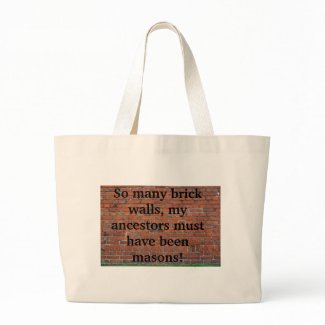
Much to the relief of every English teach I've ever had, it's the latter. I've recently opened up a store on Zazzle.com, called Wear You Came From, featuring genealogy-inspired apparel and other products for the genealogist and his or her whole family.

If you've hit so many brick walls that your ancestors must have been masons - well, I can't help you find them, but I can help you talk about it!


If you have a descendant who you love very much, here's the perfect way to show it!


If you enjoy researching black sheep ancestors because of the frequency with which they appear in court records and newspaper articles, you might like a shirt proclaiming that Well-behaved ancestors seldom make the papers.  (With my apologies to Laurel Thatcher Ulrich.)


This is just a sampling of what's available, so if you want a cool T-shirt, or a need a gift for your favorite genealogist, or the relatives who put up with your research obsession every day, visit Wear You Came From and take a look!

Monday, September 24, 2012

Church of the Visitation of the Blessed Virgin Mary, Red Hook, Brooklyn

Many of my ancestors lived in Red Hook, Brooklyn, from the 1850s and for a century thereafter. Their earliest sacraments in America took place at St. Paul's Church, an Irish church founded in 1838, but by the mid-1850s they were attending the recently founded churches closer to home: either St. Mary Star of the Sea in what is now Carroll Gardens, founded in 1851; or Visitation of the Blessed Virgin Mary at 98 Visitation Pl. (formerly Tremont St.), founded in 1854. As a result, when I recently went to the Brooklyn Historical Society to do some research in the Brooklyn Land Conveyance Collection, I was intrigued to realize that, in those record abstracts, I was watching the parish - and indeed, the diocese - grow before my very eyes.


18 May 1853, George and Eleanor Taylor to Rt. Rev. John Hughes
According to Wikipedia, Bishop John Joseph Hughes was the fourth bishop and first archbishop of the Archdiocese of New York, serving from 1842 until his death in 1864. Now, what, you might ask, is the Archbishop of New York doing buying land for a church in Brooklyn? (At least, you might ask that if you knew that the Diocese of Brooklyn and the Archdiocese of New York are two neighboring but distinct entities.)


As it turns out, it wasn't until 1853 that the Diocese of Brooklyn was founded (from territory that had theretofore been part of the Archdiocese of New York). I can't find an actual date in 1853 when the Diocese of Brooklyn was created, but it seems to have somewhat predated the consecration of the Right Reverend John Loughlin on 30 October of that year.


16 Nov 1853, John Hughes to Right Rev. John Loughlin Bishop of Brooklyn
It appears that the land was first acquired by the Archdiocese of New York, represented by Bishop John Hughes, in May, and then, on 16 November, transferred to the newly erected Diocese of Brooklyn, represented by the newly consecrated Bishop of Brooklyn, Rev. John Loughlin.


18 Nov 1865 R't Rev John Loughlin Bishop of Brooklyn to Roman Catholic Church of the Visitation, Bklyn
It's not until November of 1865 that Bishop Loughlin transfers the same parcel of land to the "Roman Catholic Church of the Visitation, Bklyn." However, according to several online sources, like Visitation's Facebook page and the website of the New York City Organ Project, the parish was founded as early as 1854 and the church building dedicated in 1855. I'm not sure why it took 10 years for the land to pass from the diocese to the parish.


15 May 1867, Martin and Margaret Shea to Roman Catholic Church of the Visitation of Brooklyn
In 1867, the "Roman Catholic Church of the Visitation of Brooklyn" (sounds a little like it was Brooklyn visiting her cousin Elizabeth in Hebron, no?) acquired another plot of land on the same block, this one from Martin Shea and his wife Margaret.


1 May 1868, Timothy O'Farrell to "The Church of the Visitation of the Blessed Virgin Mary"
Just about a year later, in 1868, added to that is still another parcel of land on the block, indicating that Visitation now owns most of the land on that block. This time, the land is transferred from Timothy O'Farrell to "The Church of the Visitation of the Blessed Virgin Mary."


2 Dec 1893, Kate A Woods to Visitation Lyceum
Finally, in 1893, Kate A. Woods leased another property on the block ("All that lot with buildings thereon known as 261 Van Brunt St.") to Visitation Lyceum. The Lyceum, or Visitation Hall, was a theater, with a gymnasium in the basement, that existed until well into the twentieth century (see the sidebar, page 13, of this May 2012 article in the Red Hook Start Review). However, it doesn't appear that the building was actually at 261 Van Brunt Street, as the address for the Lyceum is more frequently listed as being on Tremont St. (now Visitation Pl.) in the decades thereafter - although the church itself has a Visitation Pl. address, but fronts on Verona. Several of the addresses given for the Lyceum are on other blocks, so I wouldn't have come across any of the associated abstracts, as the record set is organized by block.


If anyone has any more information about the history of the parish, I'd love to hear from you!

Tuesday, September 11, 2012

September 11, 2001

[This post originally appeared on September 11, 2011.]

I've struggled with whether to blog about my memories of September 11, 2001, as suggested at Geneabloggers. It seems trite, somehow, a superficial way to treat the scariest, most vividly horrific day of my life. But I've been thinking about that day all weekend, and I want to write about it. So I'll write, and I think I may even hit "publish" when I'm done.


The night of September 11, 2001, and the afternoon of the next day, I wrote down my experiences, because I thought I'd want to remember them. I didn't realize at the time that I wouldn't be able to forget if I tried. I've never had to refer back to what I wrote when writing or telling someone how I experienced the day. The memories are too vivid, and too detailed. This will be long, I must warn you. I've tried to edit it before, and I can only revisit the memories in minute detail. They don't make any sense to me when I try to cover just the important points.

I was a sophomore in HS, in Chemistry class, when an announcement was made over the PA system. The assistant principal got on, and announced that the principal was going to make an announcement. Then the principal came on, and announced that two planes had been "purposefully" flown into the Twin Towers. My first reaction was a flash forward, to some time in the future, as I told my yet-unborn children how their grandfather had been killed the day the World Trade Center was bombed.

I specifically remember thinking "bombed," though I knew quite well that the announcement had not said that the towers had been bombed. But what word does the English language have for when you fly passenger planes into skyscrapers full of people? "Bombing" was how we conceived of terrorism at the time. It wasn't immediate that we were actually able to settle on using the word "attack" to describe what had happened that day. If you read other people's accounts of their memories, they are often full of terrified phone calls telling them to turn on the TV because "something happened in New York!" And so I thought "bombed," though I knew the word was inaccurate. But mostly, I just thought my dad was dead.

But only for a split second. Immediately thereafter, I went into what I suppose you would call "denial." It was simply inconceivable that my dad could be dead. I wouldn't be able to handle that. He just couldn't be. And so, I went about my day. "If anything's really wrong," I thought, "they'd tell me." (By "really wrong," I, in my adolescent self-centeredness, thought only of things that would affect my own life.) I had two close friends in that class who, I later found out, didn't know what at all to do with me. They knew my dad worked in the Twin Towers, but I was not at all acknowledging the fact. I simply did my chem lab. I burned my finger on some hot glass. But I didn't talk about my dad. (My sister, a floor below me, I would later learn, was crying and leaving class repeatedly to call my mom. I, meanwhile, was acting as if everything would be okay, because, well, it just had to be.)

When my first of two periods of Chemistry was over, an unusually large number of people were called down to the office. I took comfort in the fact that Laura and I weren't among them. If anything were really wrong, they'd be calling us down to the office. All those kids who got called down, those must be the kids whose parents were injured or killed. Our dad must have been okay. It didn't occur to me that it might be hours, if not days, before some people were accounted for, and that there was no way that anyone had heard from or about my father  - or anyone else's - yet.

During our second period of Chemistry, there was another announcement: a plane had hit the Pentagon. And another: all after-school activities were cancelled. And then, after that period - we were called down to the office. I went to my locker first. I took the long way to get there. I just didn't want to hear what they might be about to tell me. I ran into a friend. She said she'd been looking for me, she wanted to talk to me. I - not at all realizing the scope of what was happening, not realizing that it must be first on everyone's mind, not just my own - thought she was going to tell me what the drama with her boyfriend at the football game Friday night had been about. Instead, she asked how I was. "I don't know," I answered. "I'm going to find out." How I was depended entirely on what they told me in the office  - and again, at this point, I assumed that "they" (the office staff? my mother? the authorities?) would know whether Dad was okay.

Outside the office was a large crowd of students. One gave me a pinky-swear that my dad would be okay. I thought that was inane, but didn't say so. Another told me that my sister had been crying, really hard. I don't remember who that was, and I'm glad, because it made me think that Dad was dead and Laura had already been told. (She was probably just trying to let me know that my sister needed me.) Another told me to go talk to the woman wearing the red sweater. I went to talk to her. All she told me - this was supposed to be the big moment of truth - was that Virginia Ward was coming to pick me up. "I don't know who that is." But that was the name she had. A friend suggested that it might be Virginia R*****. She was the only Virginia we knew. Of course it was her. But I wasn't thinking clearly.

She came to pick get us, and then we had to go get my youngest sister at elementary school. Virginia asked me to come inside with her, since I was the oldest. In the front hall - there was a desk set up, anticipating the high demand for pulling kids out of school - a teacher told us that the kids hadn't been told yet. Virginia told me that I'd have to tell Anna, because she should hear it from family. I was lost. I felt like just a kid myself. I didn't know what was going on. How could this be my job?

As Anna left her classroom, she put her chair on her desk, just like everyone always had to do in elementary school. I seemed like such a normal, everyday, childhood movement. I couldn't believe it could coexist with what I was about to tell her. As we walked down the hall, she asked "Why are we getting picked up?" and I had to tell her. "A plane hit Daddy's office building." She reached out and held my hand. And then Virginia added, reassuringly, "But the plane hit very high up, and your Daddy's office was very low down, so I'm sure he'll be okay," or something to that effect. I only remember the beginning of the sentence, because it was new information to me. I hadn't known where the plane had hit, or remembered what floor Dad's office was on, and I hadn't thought to ask.

When we got to the house, there were lots of cars outside, and all I could think of was the scene in "Cheaper by the Dozen" where (spoiler alert) the kids come home after school, and they know something's wrong because of all the cars lined up outside the house, and it turns out that their father has died of a heart attack. If there are lots of cars outside, then Dad must be dead!

We went inside, where a number of my aunts and one uncle were, with my mom. Everyone was crying, and everyone hugged us. I saw Mom crying; it was to be expected. I saw several of her sisters crying; to be expected. But then I saw my dad's sister's crying face, and I knew he was dead. And then someone said something along the lines of "there's nothing we can do but wait," and I realized for the first time that no one knew anything yet. They were all just as clueless as I was. We were all waiting for news.

I remember seeing a tower fall for the first time as I walked into the TV room to greet my uncle, but I had no conscious awareness of what I was seeing. My mom went upstairs, and Virginia came over and whispered to me that maybe I should go up and check on her. This seemed uncharacteristic of me (you'll recall that I've already mentioned my adolescent self-centeredness), but I did it anyway. Mom said she just wanted to shower. I came back down. Virginia left, but soon returned with several pizzas and a few bottles of soda before leaving us to wait and watch with family. No one was hungry.

Most of my detailed recollection ends here. All the waiting was kind of a blur. I don't really know what we did with ourselves, and what I do remember, I don't remember in order. My aunt arrived, bringing with her my cousin Grace, who was not quite 2 at the time. She was, for me, literally a saving Grace. She prattled happily in baby talk, and let us occupy ourselves with something other than the news and the worry. We colored. She was just learning her colors, and that day, everything was "lello." I thought that was ironic. Or symbolic. Something. I noticed, as we stood around coloring, the outfit I was wearing - new clothes, because it was the beginning of the school year. I had on a green three-quarter sleeve shirt, with light blue jeans and a black belt. I made a mental note not to ever wear that exact outfit again - whether out of respect or superstition, I'm not quite sure, but I know I never did it.

At one point, Grace and I were alone in the play room, coloring. The phone rang. There was a bit of a commotion. I couldn't tell whether it was a good commotion or a bad commotion, and I couldn't make out anyone's words. I was terrified. For a minute, I couldn't bring myself to go into the other room. I wanted to stay where I was, pretend I hadn't heard anything, and not have to hear whatever they had learned. I forced myself to pick Grace up and go into the living room, where my mom said, "That was Lester's wife Leann. Dad and Lester are walking uptown together."

We didn't have any details - Dad and all of his friends had been trying to get in touch with their wives, but the cell phone service was overcome by demand, and most of them couldn't get through. When Lester finally reached his wife, I guess, she was given a list of numbers to call to let everyone's family know that they were alive. My family is probably not the only one that thinks fondly and gratefully of Leann, though most of us have never met her. On such a terrible day, she was the one tasked with the telling of good news, and we who received that good news have never forgotten her.

The rest of the afternoon became about logistics. Locating Dad, and other relatives at work in the city, and trying to get them home. No one could drive into the city, Dad's car was stuck in a parking garage near Ground Zero (though we had yet to hear the phrase) and mass transit was suspended. Who could get the closest to a bridge or tunnel, to pick them up as soon as they got onto the New Jersey side? How could we organize it? We got one phone call from Dad, from a restaurant he had stopped at, but after that he was difficult to reach.

We played soccer on the front lawn at one point. We might have watched a movie? My aunt brought my cousin by after picking her up from school, "because of Uncle Kevin." I hadn't even been sure that I would be picked up from school, and Uncle Kevin was my dad. I was only beginning to comprehend how much bigger this was than just how it affected me.

People were stopping by the house, some of them not even knowing that Dad had been in the World Trade Center. The best man at his wedding happened to be in town - I was reminded that it was my parents' anniversary. A coworker of his, who had mercifully taken a vacation day, dropped something off. Neighbors, friends, everyone wanted to see how we were.

Late that afternoon, two of my friends came by the front door. I stood on the step and talked to them for a while. They asked about my dad; they told me how school had gone after I left. They told me that Samantha D*** had been crying in gym class. "Why?" I asked. They looked at me like I was crazy. "Because of your dad." I was still so focused on how I was being affected that I wasn't aware of what the attack meant to other people, those who knew my family and those who didn't, those who were in the towers and those who weren't.

Then we saw someone walking up the road, his shoes in his hand. I assumed it was some dumb teenager. Who else would carry his shoes in his hand for no good reason? "Who is that?" I asked. My friend faltered. "I . . . I think it's your dad." It hadn't occurred to me that he would be walking home, and so it hadn't registered that it could be him. I stayed on the step, unsure of what to do. Should I run to him, or run inside to tell everyone else that he's home?

Suddenly, my mom burst out of the side gate, somehow having seen him coming from the backyard. She was followed by my sisters, my grandmother, and everyone else at my house. I, too, went over to them, and we had our reunion near the top of our next door neighbor's driveway.

There's more, of course: the church service that night; doing my math homework before bed, since I was pretty sure my new math teacher was so strict she wouldn't find even a national and personal tragedy to be a reasonable excuse for not handing in your homework; crying on the soccer field the first day that after school activities returned, as the physical exertion finally caused my emotions to overflow; the dreams I had in the weeks after, where I watched my dad die on TV; gathering at my grandmother's on Friday, with a "God Bless Kevin" cake, so that everyone who had worried about my dad could see him. My experience of September 11 extended well past the hours of the actual day. There are things that happened months or even years later that I consider part of my memories of that day.

Wednesday, September 5, 2012

The Quinn Family

(An occasional series outlining one of my ancestral families.)

Hugh J. Quinn and Mary Gillen (Gillan) were my 2x great-grandparents. Mary Gillen was born c. 1868 in Tawnykinaff, Co. Mayo, Ireland, to Martin Gillen and Honora Grimes, and immigrated to the US some time in the late 1880s or early 1890s. Hugh Quinn was born c. 1868 (possibly in Co. Antrim, though I'm still looking for confirmation). They married c. 1893, and had 5 children: Nora Agnes, Anna Mary, Helen, Martin, and Terrence. Nora Agnes Quinn, known as Agnes to family but often officially recorded as Nora, was born 5 December 1894 and married William Augustus (Bill) Maines, 3 July 1932. Anna Mary Quinn, known as Molly, was born 22 Mar 1897 and married John O'Hara, 31 Mar 1923. (Until this summer, there was no indication that her first name was anything but Mary.) Helen Quinn was born in 1899 and married Harry Kunze, around 1924. Martin Quinn was born c. 1902 and married Elizabeth "Bobbie" Byrnes around 1930. Terrence Quinn was born 3 July 1904 and married Alice, but I don't know her maiden name or when they married.

I unfortunately don't have a good picture of the whole family. I've never seen a picture of Hugh Quinn, but I have this nice picture of Mary Gillen Quinn and her daughters.

Back row, L to R: Unknown, Helen Quinn Kunze
Middle row: Agnes Quinn Maines, Molly Quinn O'Hara, Mary Gillen Quinn
Front row: two unknown children
There's also this picture, which I believe depicts the brothers Marty and Terrence Quinn. Certainly the man on the right is Marty, and I'm fairly sure that the man on the left is Terry.

Terrence and Martin Quinn

Monday, August 20, 2012

More than you ever wanted to know about the Rothwells and Mulvanys* of Kells, Co. Meath (but rather less than I want to know about them)

As I related in an earlier post, I was recently blown away to discover that two associated Mulvanys (James and John), both from Kells, Co. Meath, and both living in Brooklyn from the 1850s on, were both married to women with the maiden name Rothwell (Bridget and Ann). James Mulvany and Bridget Rothwell were my 3x great-grandparents, and John Mulvany and Ann Rothwell were, it seems, related to them some still-unknown fashion. In 1860, the two families were living in the same building in South Brooklyn. In the 1880s, members of both families were buried in the same grave.

In my last post, I promised to let readers know "where these two Rothwell-Mulvany families take me." It occurs to me that this might have given the impression that Part II would be a wrap-up, a conclusion. When I said that this discovery "might have blown my Mulvany line wide open," or that this discovery "changes everything," it might have seemed like I was suggesting that it had led me to an answer.

I'm going to say up front that that's not the case. Of all the things that this discovery changed, what stayed the same was that I'm dealing with questions, not answers. More questions than ever, really.

Here's how I'm trying to answer those questions.

I went to the Irish Family History Foundation's website and was able to find the marriages of Bridget Rothwell and James Mulvanny, 2 March 1850, and of Anne Rothwell and John Mulvany,  19 July 1851, both in Kells. An Anne Rothwell is one of the witnesses for James and Bridget's 1850 marriage, and a James Rothwell is one of the witnesses to Anne and John's wedding. (A James "Bothwell" immigrated later in 1851, listed on the ship's manifest immediately beneath a James and Bridget Mulvaney.)

Manifest of the John Hancock, 13 November 1851

I was not, however, able to find birth records for Bridget or Anne Rothwell. I have no idea who Bridget Rothwell Mulvany's parents are: they're not listed on her marriage record, or in her obituary, and she died long before New York City (rather, Brooklyn) required they be listed on her death certificate. However - Ann Rothwell Mulvany lived to the ripe old age of 90, dying in 1921, well after New York City (long unified) began asking for parents' names on death certificates. That certificate - something I would never have thought important to order, before this unexpected discovery - obviously became the very next item on my list of records to acquire.

It showed up recently, and, of course, it didn't quite blow anything wide open, but it did offer some clues. Ann's father's name is recorded as John. Her mother's name is unknown.

Death Certificate, Ann Rothwell Mulvaney, 30 September 1921

Now, buried with John Mulvany (Anne's husband) were James and Bridget as well as a John Rothwell, whose age indicates that he is of the same generation as Bridget and Anne (not their father). John Rothwell died 21 December 1894, and his death certificate gives his parents' names as John and Mary.

Death Certificate, John Rothwell, 21 December 1894

That they both have fathers named John suggests that he and Anne, at least, might have been siblings. However, according to the records available on the IFHF site, the only John Rothwell who was having kids in Kells in the 1830s (or any time thereabouts) was married to a Rose, not a Mary. And while John and Rose have a son named John of approximately the right age to be John Rothwell, son of John and Mary, they don't have a daughter named Bridget (but then none of the Rothwells in Kells have a daughter named Bridget who's anywhere near the right age), and their daughter named Ann is about 5 years younger than she should be. Five years here or there shouldn't seem like much, but being born in 1837, like this Ann Rothwell, would have made our Ann Rothwell a mere 14 years old when she married John Mulvany in 1851. It would also mean, if all these Anns are really the same Ann, that she was only 13 when she was a witness at the wedding of Bridget and James. (One source I just found, after a quick google, suggests that there is currently no minimum age for witnesses under Canon Law.)

Even more than the Mary/Rose discrepancy, and the lack of a Bridget, this seemed to raise a significant objection to my hope that I was identifying the correct Rothwell family. My understanding is that marriage before the late teens or early twenties was quite rare in most European countries. (Not recalling the several sources where I had read this, I checked Wikipedia, which quotes an average age at first marriage of 25.) It seemed unlikely that Ann Rothwell had married at 14. Unlikely, not impossible. But it certainly didn't point to this being the correct Ann Rothwell.

I remembered that there was one more record I should be looking for in Ireland, the birth record of Ann and John's firstborn son. In all U.S. census records, their children are identified as American-born, with the exception of their eldest son, Michael, who is routinely recorded as having been born in Ireland. I knew when he was born, within 2 or 3 years, and if they married in Kells, I could be reasonably sure he was born in Kells. (One thing that I know, but can't get around, is that just because Bridget's obituary says she was a native of Kells, and just because both couples married in Kells, doesn't mean that any of them actually was born in Kells. But Ireland has a lot of towns, and so far this is the only one with any indicated connection to the Rothwells/Mulvanys, and so I'm looking here, until I have reason to look elsewhere.) I was just making sure to accumulate all the records associated with this family, and I quickly found out just why that's so important. I easily found the baptism of a Michael Mulvanny, born in Kells to John Mulvanny and Anne Rothwell, on 19 September 1851.

Did you do the math? He was already being baptized 2 months to the day after his parents' wedding. All of the sudden, marriage at 14 doesn't seem quite so improbable - at least, no more improbable than pregnancy at 14!

So there's a good chance that Ann Rothwell Mulvany is the daughter of John and Rose Rothwell, and was born in Kells, Co. Meath, in 1837, got pregnant at 14, married John Mulvany (parents to be determined), gave birth to a son, and soon thereafter immigrated to the United States. But where does that leave John Rothwell (son of John and Mary)? And where does it leave Bridget Rothwell Mulvany, who, after all is my direct ancestor and so the Rothwell whose parents I most want to find?

Ann's early marriage sent me back to the records to look at Bridgets again, Bridgets who fall outside of the age range that had originally seemed reasonable. There is a Bridget Rothwell born in Kells in 1805, but I still don't like the looks of her. This would put Bridget's age off by a solid 20-25 years in all later records. That's an entire generation. And then there are 2 Bridget Rothwells born in 1839, one to James and Mary, the other to Thomas (mother's name not recorded, but likely Catherine). An 1839 birth date would put Bridget's age off by about a decade in later records. (The several later records I have with ages or birth years indicate birth in 1829, 1832, 1815, 1832, 1832, 1828, 1828). It would also mean that she was married at 11.

Eleven. It couldn't be, could it? Just in case, I went back to check the birth records in Kells again. If we had another one of these babies that came not quite 9 months after the wedding, I wouldn't be so sure. But no babies showed up in the 9 months after the wedding, nor, indeed, were there any at all born to James and Bridget in Kells before their 1851 immigration. That makes their earliest known child Mary Ann Mulvaney, who was baptized 7 April 1852 at St. Paul's Church in Brooklyn, and who is most likely the same Mary Ann who was buried in the Mulvaney-Rothwell plot at Holy Cross Cemetery on 6 June 1854. With 25 months separating James and Bridget's marriage from Mary Ann's birth, there's no evidence that shotguns were involves in the union, although 25 months is long enough that I might suspect there was another pregnancy, if not another birth, in there somewhere. (Unless she really did get married at 11, and didn't hit puberty until some time after the wedding. But I think that would be a highly unlikely situation.)

Then I had another idea. Back when I was searching the IFHF for Rothwells, and searching for Mulvanys, it seemed necessary to limit my search to Kells.  Mulvaneys in particular are quite common in Meath, and Johns and Jameses don't exactly narrow down the search very much. But Rothwell-Mulvany couples are much less common, and I realized I could search the whole county to find out if there were any other couples from these families, or if our couples had had children baptized anywhere other than Kells. This was a brilliant idea, which nonetheless yielded only the two marriages and one birth that I already knew about.

That's all I've got, for now, and it certainly isn't an answer. My next step is to check the Board of Guardians minute books, 1839-1917 from the Kells Poor Law Union; the Court Records of Kells, 1851-1921; and the book Kells Burial Grounds, County Meath, by author Eileen Hewson. I'm hoping they offer me something, because if they don't, I'm not sure what other avenues to pursue.

Of course, there's a reason I called Part I of this post "On ordering every record of everyone, ever." I discovered the Rothwell-Mulvany link by accident, when I ordered a death certificate that I didn't think would teach me anything of much importance.  There's information you didn't know you needed in places you didn't know to look for it, which means that if the above promising sources don't bear fruit, I'll be spending months, maybe years, working my way through the acquisition and analysis of the death certificates (and other records, where they exist) of the combined 16 children of the two Mulvany families, hoping for another thunderbolt out of the blue.

*Although my family spells the name Mulvaney, it seems to have reliably been Mulvany before about the 1890s (sometimes Mulvanny, but never Mulvaney), so I tend to drop the e when talking about the 19th century, and add it back in when talking about the 20th. For the sake of not confusing the heck out of people, I'm trying (sometimes failing) to stick with one spelling per post.

Monday, July 30, 2012

We're not normal

I just had the following brief exchange with my husBen:*

He had noticed the Application for Copy of Birth Record I was filling out.

Ben: Whose birth record are you ordering?
Me: Mine.

Around here, that answer is so unusual that we both burst out laughing. Then I thought about the fact that normal people would never find themselves ordering the birth records of anyone but themselves (and maybe their own children). Not Grandma, or Papa, or 2x great-uncle Edgar. When I think about the absolute treasure trove of information in the file cabinet to my left, about all of the facts and assertions and data, about real people who I'm related to, about the millions of stories that come together to become a family history, I have to be glad we're not normal people. What's interesting about only being concerned with the facts of your own life?


*He hates when I call him that. But it's so clever of me!

Monday, July 23, 2012

On ordering every record of everyone, ever.

Like most people with limited time and funds, I tend to focus primarily on my direct ancestors and turn to more distant, tangential lines only when necessary. But a few months ago, I had an extra line on the request for photocopies that I was about to send to the Family History Library, and on a lark, I spent $2.00 on the death record of a very tangential relative, not expecting it to add anything to my body of knowledge besides her cause of death. Boy was I wrong! When the record arrived, I read it, did a double take, read it again, and realized it might have blown my Mulvaney line wide open.

My great-great-grandfather was Patrick Mulvaney, whose parents were James Mulvany and Bridget Rothwell. Patrick was born in Brooklyn, NY, but his parents were, by all indications, from Kells, Co. Meath, Ireland. Now, while James and Bridget (Rothwell) Mulvaney from Kells were raising their family in Brooklyn, there were several other Mulvaneys in Brooklyn. Deputy Sheriff Mulvaney doesn't seem to have been a relation, though goodness knows I wish he was, what with all the newspaper appearances he made in the course of doing his job. Luke and Edward Mulvaney seem to have been rather more well-to-do than my Mulvaneys, and they don't appear to have ever interacted. But John and Ann Mulvany - they must have been relations of some sort.

The two Mulvany families live in the same neighborhood. Heck, in 1860, they live in the same building! James and Bridget Mulvany and their children are living in the same building as John and Ann Mulvany and their children. They never show up together on the census again, but members of each family end up buried in the same grave when John, James, and Bridget all die in the 1880s. They're joined in that grave by James's brother Mathew and a John Rothwell who must have been related to Bridget, right? There is every indication that these families are related through James and John Mulvany. They could be brothers, maybe cousins, but I've been working under the assumption that the two men are related somehow. And then . . .

I have an interest in the life and story of John and Ann's daughter Julia. Her story is not one that I'll be ready to share until I know how all the pieces fit together, but I'm interested, right now, in trying to learn as much about her as I can. She's quite a collateral relative - at most, the first cousin of my 2x great-grandfather - and hers is the record I ordered on a whim. She died in 1928. When it arrived, I read it, and then, as related above, did a double take and read it again. Then I asked my husband to read it. Did the handwriting look the same to him? Did that really say that her mother's maiden name was Ann Rothwell?!


I've spent all this time assuming that the two Mulvaney families are related paternally, because their fathers share the same last name. I still think they're related - circumstantial evidence points to it, perhaps even more strongly now - but now there's every possibility that they're related maternally instead of - or in addition to - paternally, because their mothers also share the same last name.

Stay tuned to find out where these two Rothwell-Mulvany families take me!

Part II is here