Monday, December 23, 2013

A Visit to Tawnykinaffe, Co. Mayo

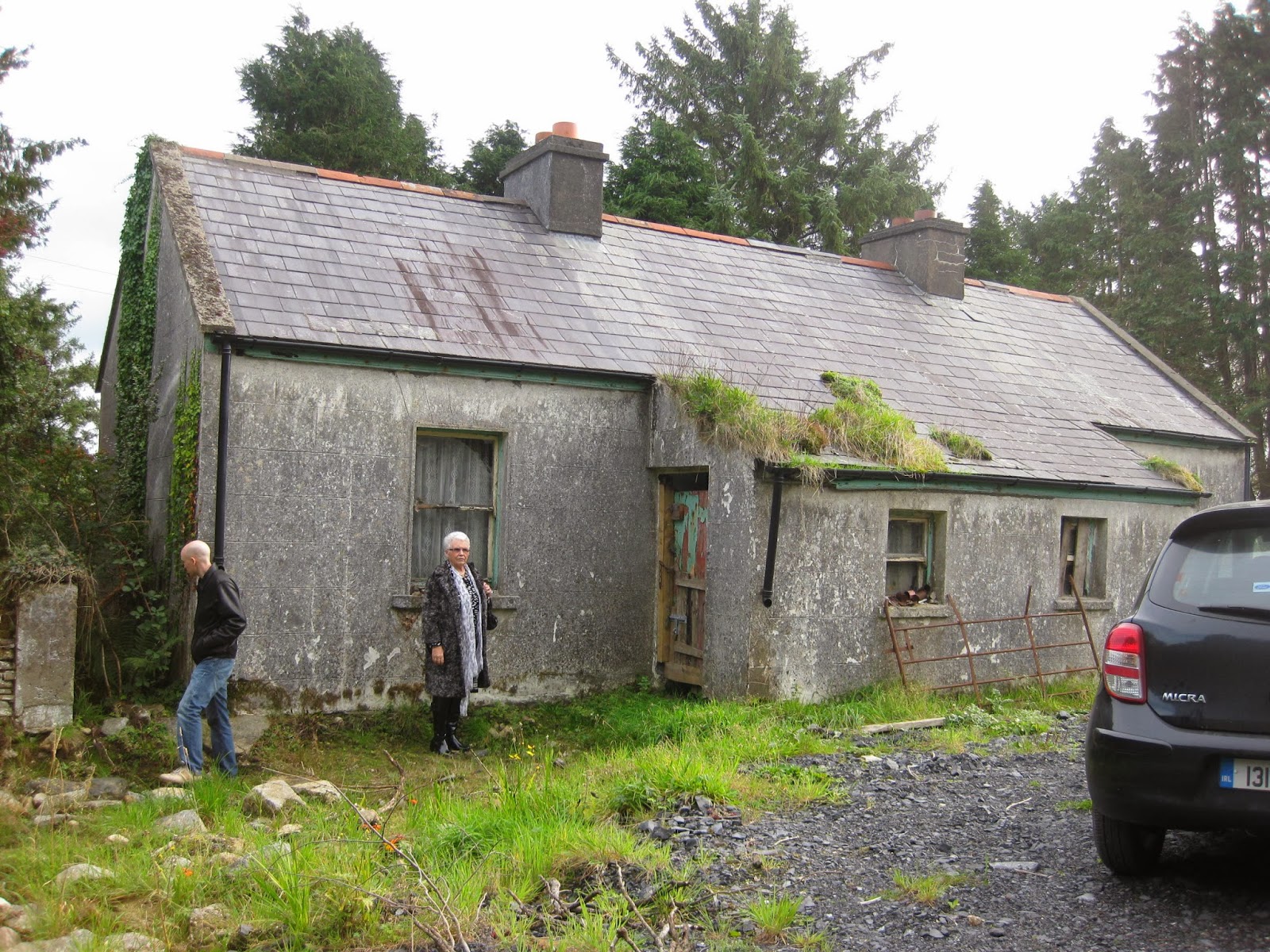
When we were in Ireland recently, we met up with some of my Gillan cousins, who took us out to the small town of Tawnykinaffe, Co. Mayo, where my great-great-grandmother Mary Gillan was born. Although the property is no longer in the family, my cousins had grown up there and so were fantastic tour guides. There are two houses right next to each other, the original one-room cottage and the larger house, built c. 1940. After the family moved into the newer home, the older building was used as a barn. Both are now abandoned.
The new house
The original house
After I got home, one of my Gillan cousins sent me this 1931 picture showing Michael Gillan (born c. 1910) in front of the same house we'd visited.
Michael Gillan, Tawnykinaffe, 1931
I'm not sure whether the appearance that the door is in a different place is just a question of angles and perspective, an indication that the entrance was moved at some point, or evidence that the picture was actually taken from the opposite side of the house (as I can verify that there are both a front and a rear door; I walked through both).

This little corner of Tawnykinaffe, with only a few houses, most of them empty, seemed quiet and isolated. It was a little surreal to hear stories of how bustling, active, and full of life the neighborhood had been as recently as the mid-twentieth century. It was also challenging to mentally eliminate the encroaching trees to try to picture the landscape as it would have been before the Irish government planted them en masse, at some point in the last 50 years. Though they look full grown, they're actually a very recent feature. It's easy, when visiting a town, to look around and identify new buildings and modern technology and realize that the scenery has changed in the last 50 or 100 years. Without my personal tour guides, though, it never would have occurred to me that natural features like trees - particularly in such numbers - might also not have been a long-standing feature of the environment.
I managed to peer through the trees for a glimpse of the view that predated them.

After visiting the family homestead, we went out to lunch in Pontoon. This was cool for me, because Tawnykinaffe is so small that Google Maps can't always find it. To get a general idea of the area I was looking for, I used to search for nearby Pontoon, instead. Pontoon is easy to identify because it falls right between two lakes that are very close together, separated by only a bridge. This is a feature that stands out on a map, and is easily identifiable as you drive across that bridge in your car!


View Larger Map

Ben and I on the Pontoon Bridge

We had a fantastic time and a lovely lunch and I felt so lucky to be able to meet so many of my cousins and have a personal tour of the place my ancestors had lived.

Our last Gillan family stop was a trip to the cemetery, but I will save that post for another day.

Monday, December 16, 2013

On grief and cookies

On July 26, 2013 my grandmother, Laura Lanzillotto Gatto, died. It was the Feast of St. Anne. It was not unexpected, but was nonetheless devastating. My mom later told me that when she called to tell me, I "couldn't form a complete sentence." I'm not sure I was trying to. What is there to say?

Instead, I did the only thing that made sense to me at the time. When I hung up the phone with my mother, I walked to the kitchen and took 1 1/2 sticks of butter out of the fridge to soften. Not until they were on the counter did I call my husband, or start to cry. It may have been the first time I ever remembered to take the butter out to soften.

My grandmother's most famous recipe, the food she was best known for, were her biscuits. (That's bis-coots, accent on the second syllable. The vowel sound is closer to that in look than in loot.) Both the name and the recipe are derived from biscotti, but we never called them that, and they are, truly, a completely different cookie.

I'm fairly certain that I got my first job out of grad school due to my education, experience, relevant skill set, and, perhaps most importantly, the fact that the interviewer had once had Grandma's biscuits at a bake sale.

No one has ever been able to replicate Grandma's biscuits exactly, despite sustained efforts. We've been trying for years. She didn't bake from a recipe, so every recipe she wrote down was slightly different from the last, and you always had to cross your fingers and hope that this index card was going to be the index card that got everything right. Grandma was known to look at a biscuit recipe in her own handwriting and ask, incredulous, "Where did you get this? I never would have told you to put [so much butter, so little butter, so much flour, etc.]!" My cousin has come really close to replicating Grandma's biscuits, and I had a couple of good batches in high school that got everyone's hopes up before my luck wore off. My husband irritated me by coming closer with his biscuits than I ever do with mine, despite the fact that we work from the same recipe card and I share Grandma's genes. My mom's are good, but they're not the same. 

I had not planned to bake that Friday, of course. I had the day off, but was hoping to research at the NYC Municipal Archives. My major worry was that I couldn't find my research notebook. What ended up mattering, instead, was that I didn't have enough sugar or flour, but I'd already begun creaming enough butter to make a full batch. So I improvised. I put in as much sugar as I had in the pantry, and stopped there. I substituted whole wheat flour for what was missing of the white. This was not an effort to replicate Grandma's cookies. This was a desperate attempt, a clawing at the air, to capture whatever I could of her essence, her routine, her personality, her legacy. My biscuits tasted fine, but they were nothing like Grandma's.

Baking may have been an irrational response to my grandmother's death, but I was not unique in crying into my cookie dough. The night after my grandmother died, my cousin - the cousin who comes so close with her biscuits - began baking.  She made multiple batches, each one tweaked slightly. She had taste testers. She took notes. She was determined to get them right. She came a lot closer than I did.

And yet, my grandmother had told me where her recipe came from. She took her mother's recipe, and her mother-in-law's recipe, and changed them to suit her taste. She removed the lard from one, substituting butter so they would be healthier. She eliminated the yeast, preferring the rise she got from baking powder. In some sense, I think that the pursuit of the perfect biscuit is the pursuit of a fiction, something that doesn't exist - or that, at the very least, is a moving target. Even Grandma's were not necessarily the same from one batch to another. She'd improvise if she ran out of ingredients. She sometimes added cinnamon. Grandma didn't inherit a finished, perfected biscuit recipe, so why should we expect her to leave us one? Maybe the tweaking, the changing, the improvising is as much a part of the legacy as the taste of the perfect cookie.

But even knowing that didn't make it any easier when, on the night after the funeral, I waited until everyone else had gone to bed, took from my mom's cookie jar what I knew would be my very last of Grandma's biscuits, and savored it through my tears.

Monday, December 9, 2013

The Martins Gillan

When we were recently in Ireland, we visited with several of my Gillan cousins, who showed me the family's old homestead in Tawnykinaffe, Co. Mayo. They were kind enough to give me a copy of a photograph of my 3x great-grandfather Martin Gillan:

Martin Gillan and grandson Martin Gillan of Tawnykinaffe, County Mayo, Ireland, c. 1912. Photographed in Castlbar.
Martin Gillan and Martin Gillan, c. 1912
Castlebar, Co. Mayo, Ireland
Standing next to Martin Gillan (seated) is his grandson, Martin Gillan, son of the elder Martin's son Michael. The younger Martin was born c. 1900, and the best estimate of the date of the picture is around 1912, based on the belief that he looks to be about 12 here. I'm told that the photo was taken at the studio of a professional photographer in Castlebar.

This makes two photographs I have of Martin Gillan, which is two more than I have of any of my other 3x great-grandparents. He lived nearly another 20 years after this picture was taken, and the other photo, which was sent to me by another Gillan cousin a couple of years ago, was clearly taken much closer to the end of his life.

As far as I'm aware, there are no extant photographs of Martin's wife Honor Grimes Gillan. I don't know exactly when she died, but she was alive when the 1911 Census was enumerated, so she lived well into the age of photography, and I continue to hold out hope that a picture of her will show up eventually.

Monday, December 2, 2013

Genealogy Gift Guide 2013: Gifts to Share Your Family History

If I get a chance, I hope to publish a guide to gifts for genealogists, but I'm going to start with a guide to gifts from genealogists. How can you share your passion for family history with your loved ones? (You know the loved ones I mean, the ones who get the glazed-over look in their eyes when you start talking about genealogy.) How can you preserve and disseminate your family history in a way that's interesting and family-friendly? Here are some of my favorite ideas!

-Family Tree
There are lots of ways to present your family with a nice "completed" version of your family history in an attractive format that even a non-genealogist would love to hang on the wall. Ancestry.com offers printing services, and your genealogy software may print a tree nice enough to display.  Family ChartMasters offers a multitude of options. Personally, I've ordered blank charts from Etsy seller Fresh Retro Gallery and filled them out as gifts that were always well-received.

-Photo Ornaments
Photographic ornaments like these can hold current pictures of family members or memorialize Christmases past. You could even give a set each year, with updated pictures of kids or grandkids to create a future heirloom and tell your family story in real time!

-Photo Coasters
A few years ago, we got this lovely set of photo coasters from a family friend for Christmas. While ours were empty, you could pre-fill the coasters with old or new family photos (copies only, please!), pictures of the old homestead, or even artistically cut excerpts of important documents (really, copies only, please!) to create a conversation piece that will really get family members talking about memories and stories whenever they gather for a beverage.

-Framed Photographs
Any picture in a frame can be a gift, but to really make it worthwhile, pick family pictures that mean something, or arrange them in an artistic way. There are a million ways to go about this. This year, my in-laws are getting a photograph that we took on our trip to Ireland, of the farm where my mother-in-law's family has lived for up to 200 years. It's not exactly an "old family photograph," but it's definitely a picture full of family history! They're also getting side-by-side framed pictures of family photo from the early 1900s and my husband recreating the shot in 2013:

Listowel, Co. Kerry, Ireland. Left: Joseph Gleasure, c. 1905. Right: Ben Naylor, October, 2013.

-Scrapbooks
These are best when they tell a particular story. Memorialize a piece of your family's recent or ancient history - anything from your family's Christmas memories, to a new baby's first year of life, to the life story of a particular ancestor. If you're interested in digital scrapbooking, try the MyMemories Suite. It's the tool I used to create the header for this blog, and it can make wonderful scrapbooks, as well. You can read my review here. If you plan to buy MyMemories software, you can use the exclusive coupon code STMMMS25444 to get a discount on your purchase.

-Family Stories
I know you pay attention when relatives tell stories. I hope you write them down. And now, I encourage you to share them! Using a service like Lulu.com, you can compile them into a nice book or booklet, illustrate with relevant family pictures, and order copies for the whole family, or make it available for purchase by relatives or the public. I did this last year with stories my grandfather had told us years earlier, and ended up with a really nice-looking book, a preview of which can be seen here. (Everyone who received a copy cried. I consider that a successful gift.)

-Oral Histories
Record an oral history with a relative. With permission, share with family members. Satisfaction guaranteed!

-Family Cookbook
Gather recipes from relatives, or compile your own most famous recipes to share. You can write them out by hand if you're only making one copy; otherwise, please spare your wrist and get them printed up! This can be another job for Lulu.com, or you can print up recipes and photos together in a photobook from Shutterfly or Snapfish. Make a family cookbook particularly compelling by organizing it around a theme: Grandma's famous recipes, or family Christmas favorites. Tell the stories that make your family dishes so memorable.

Edited to add:
-Home Movies
How many old home movies do you have on VHS, or even on film? There are services that can transfer these to DVD, creating a much more accessible trove of family memories. If you have access to a combination VCR/DVD player, you can even do it yourself! I bought a selection of DVDs and jewel cases, and am in the process of transferring a number of old movies to DVD for my parents. Be warned, though: regular DVDs are not an archival medium, and you should not discard your originals! If you're willing/able to pay up to buy Archival Gold DVDs, you should, but I'd still recommend keeping the originals, particularly if your originals are on film. VHS tapes aren't archival, either, and won't necessarily outlast your regular DVDs, but duplication is always smart.

I hope you can take away from this post some creative ideas about how to share your research and your family's history with your loved ones this holiday season!


Disclosure: This post contains Amazon.com affiliate links. This means that if you choose to make a purchase from Amazon after clicking one of these links, I will receive a small portion of your purchase price as a commission. I personally make a point of starting my Amazon shopping through the affiliate links of bloggers and friends whenever possible, so that large corporations are not the only beneficiaries of my purchases, and encourage others to do the same, regardless of whether they use my affiliate links or another blogger's. Additionally, I am a MyMemories affiliate, and can receive a small commission if you purchase their software using the above code.

Monday, November 25, 2013

Blind Spots

Every so often, in the course of my research, I come across something that makes me say "Duh! I already knew that!" or smack myself on the forehead and ask "Why wasn't I looking for that?" These moments always make me doubt myself, because how could I be so dumb? One occurred this weekend.

It had been awhile since I focused on Italian research; thanks to my recent trip to Ireland, I'd been seeing genealogy through emerald-colored glasses. This weekend, however, I finally had some free time and decided to return to Antenati, the Italian government website that houses vital records online.

I was looking for the family of Domenico D'Ingeo and Anna Pace, and I really thought I wasn't going to find any more of them; I was just being thorough. They had 5 kids (right?): Vincenzo, Rosa, Angelica, Giovanna, and Maria. The eldest two were certainly born in Italy, but it seems that the younger girls were born after the family had moved to Brazil. (This is a point of contention in the family, but although I can't prove it yet, I fall into the "probably born in Brazil" camp.) Having already found birth records in Italy for Vincenzo and Rosa (plus an earlier Vincenzo and Rosa who died as infants), I wasn't expecting to find anyone else. However, the Brazilian records on FamilySearch are not indexed, so I wanted to cover all my bases in Italy before tackling that project. (The Italian records on Antenati aren't indexed, either, but I know where they lived in Italy, and browsing the town of Toritto is far less daunting than browsing the entirety of Brazil.)

coffee plantation, Brazil
Coffee berry pickers, probably in Sao Paulo state inland, Brazil
By Frank and Frances Carpenter Collection. Copyright by E.M. Newman. No known restrictions on publication (Library of Congress) [Public domain], via Wikimedia Commons. https://commons.wikimedia.org/wiki/File:Lavoura_de_caf%C3%A9.jpg

I was surprised, then, to come across a D'Ingeo born in 1896, and it was not Angelica, Giovanna, or Maria - it did not disprove the "born in Brazil" theory. It was someone I'd never heard of before: Francesco D'Ingeo, b. 5 Oct 1896. Unknown babies are, of course, not uncommon in genealogy, and I figured that this boy was another baby who had died young and who hadn't been recorded in the family oral tradition or shown up in later records. (See: the first Vicenzo and Rosa, who I hadn't known had died in infancy.)

Then I realized how wrong I'd been: I don't think Francesco actually was unknown. Another child, likely he, figures prominently in the family's "creation myth," as it were:

After Anna died, Domenico remarried (or lived with someone? or had a housekeeper? There was another woman in the house) and she mistreated the kids. When he found out, he decided to move the family to America, but while they were on the trip over, the quota was filled and the ship was turned away and went to South America instead. They settled in Brazil, where they lived for a number of years. While there, one of the sons was run over by a trolley (or horse and carriage? or wagon?) and killed. Sometime thereafter, the family moved to America.

There are a lot of differences of opinion in the family, and plenty of demonstrated inaccuracies in this account, from the fact that it all happened before the US even had immigration quotas; to likelihood that several of the children were born after, not before, the family arrived in Brazil (and that Anna was likely with them when they made the move); to, apparently, the fact that they went from Brazil back to Italy and then to America. But no one has ever expressed any doubt that there was a brother who was killed.

The brother's death certificate was on my list of records to find. His birth certificate was not. I always though of him solely as a boy who died, and somehow, not as a boy who was born. I never wondered what his name was, or whether he'd been born in Italy or Brazil. He showed up in an otherwise-suspicious story and while I didn't doubt his existence, I really didn't give it any thought, either.

And when I came across him (probably) in the 1896 Atti di Nascita, it never occurred to me that it could be him. Of course, I'm not done with the Italian birth records yet, and haven't begun on the Brazilian ones. Maybe Francesco was a baby who died young, and the brother who was killed was someone else entirely. Regardless, I had such a blind spot where he was concerned that I found myself inventing a place for this "new" child in the family - a plausible one, of course, but one that completely ignored what I already knew.

I'd like to close by asking you to look at your own blind spots, but they're the kind of things you don't know exist until they show up and make you feel like idiot. So instead, I'll ask you to make me feel better: am I the only one this happens to? Or have you ever realized that you're completely ignoring something you already knew?


May 30, 2016: This post submitted as a part of the Genealogy Blog Party at Little Bytes of Life, for the topic "What Was Your Genealogy 'Duh' Moment?"

Monday, November 18, 2013

False Friends

When I was in learning Italian, beginning in middle school, a teacher introduced us to the concept of "false friends." These are false cognates - words in Italian that sound similar to English words but don't have similar meanings. Some examples include:
  • fattoria - farm
  • camera - room
  • parenti - relatives

If you assume that they're real cognates and mean what it sounds like they mean (factory, camera, parents), you'll definitely be misled.

I sometimes have fun looking around my home and figuring out which of the things I own might be the "false friends" that would lead my descendants astray in their future genealogical research. A few examples come to mind. (I'm going to use Smith for all the surnames here, since the whole point is that they're not my family.)

  • When I was in 10th grade, my English class read Sir Gawain and the Green Knight. As was usually the case, the books belonged to the school, and we read them and then turned them back in to the teacher once the unit on the book was over. For reasons unbeknownst to me, a boy in my class, Alon Smith, wrote his name in the front cover of his book. Then, like he was supposed to, he returned it to the school. Fast forward one year: My sister Laura is in 10th grade, and her English class reads Sir Gawain and the Green Knight. The only difference is that this year, the school has decided to replace the books, and so, as the last class to use the old books, Laura and her classmates are allowed to keep them. Sure enough, the copy she brings home is the copy that Alon Smith had used the previous year, with his name inside the front cover. It currently lives on the bookshelf in my old room at my parents' house. If this book survives the generations and remains in my family, what will that name lead my descendants to think? Probably not quite what I wrote above! Alon and I were friendly, and ran in the same circles, but anyone searching for the "real" reason why "his" book had become a part of our family library would be led astray if he thought that an intimate friendship or a romantic or familial relationship were part of it. (Of course, if someone were looking to find out where we'd lived or what high school we went to, Alon "Smith's" much more unusual name would be more likely to point them in the right direction in an index or an online search. Might he lead them back to us eventually?!)

  • Last week, at my parents' house, we spent some time watching old home videos. One shows a couple of bored adolescents dyeing Easter eggs (and one not-bored 7-year-old who can't get enough of saying "Happy Easter 1999!" to the camera and getting others to do the same), while off-screen, my dad and my aunt discuss the story behind a divorce. As we listened to this 15-year-old conversation, my mom looked at me and asked "Who are they talking about?" My mind went through the divorces in our family, none of which seemed to have the characteristics being discussed, and many of which hadn't yet occurred in 1999. My mom figured it out first: "The Smiths!" There is no identifying information in the conversation, and no one who didn't already know of the couple in question could ever have figured out who was being discussed. The divorce in question had happened probably decades earlier. While no one will be led to the Smiths (a completely unrelated family) by watching this old movie, can't you just imagine a casual researcher assuming a family relationship and, erroneously and perhaps unconsciously, assigning the back story of the Smiths' divorce to a couple in our family tree?

  • This one is a little less incidental and little more predictable: A couple of years ago, I purchased a 1961 Catholic Missal from a local thrift store for 99 cents. I was interested in it for the historical and liturgical context. Inside the front cover is the name Theresa Smith, and the next page has the names of several of her relatives. I knew when I bought it that this could be confusing for someone, someday, but the price was good and I was interested in the earlier iterations of the Mass, so I got it anyway. I have not marked it to indicate that the (thoroughly enumerated) family is not mine. I have not tried to find the family in question, or return it to them. (I bought it because I wanted to have it. Is that so wrong?)

Does anyone else ever think about what might mislead your future descendants? Pictures of random acquaintances you barely remember, marked-up books that you bought used, ephemera you rescued to return to descendants who you were never able to find? Do you do anything to mitigate that risk?


Monday, November 11, 2013

A Visit to Castlebar, Co. Mayo

When I was a kid, I learned that "Pop's family came from Castlebar and Nan's family came from Pallasgreen." This was just over half true; as it turns out, all of Pop's family really was from in or around Castlebar, but while Nan's most recent immigrant ancestor (Michael Mulcahy) was from Pallasgreen, most of the rest of her family had been in the USA since the Irish potato famine and everyone had long since lost track of their origins.

I had visited Castlebar once before, when my family visited Ireland when I was about 12. What we knew then was what we had been told by my grandfather (the aforementioned "Pop"): that his father's ("Grandpa JJ") last memory of Ireland was of being asked to run up the hill to the post office to mail a letter to the family back home in New York to let them know they were leaving. I know that at the time, I wasn't clear on whether JJ had been born in Ireland or the US - I may have assumed he'd been born in Ireland since he'd lived there, but that wasn't actually the case.

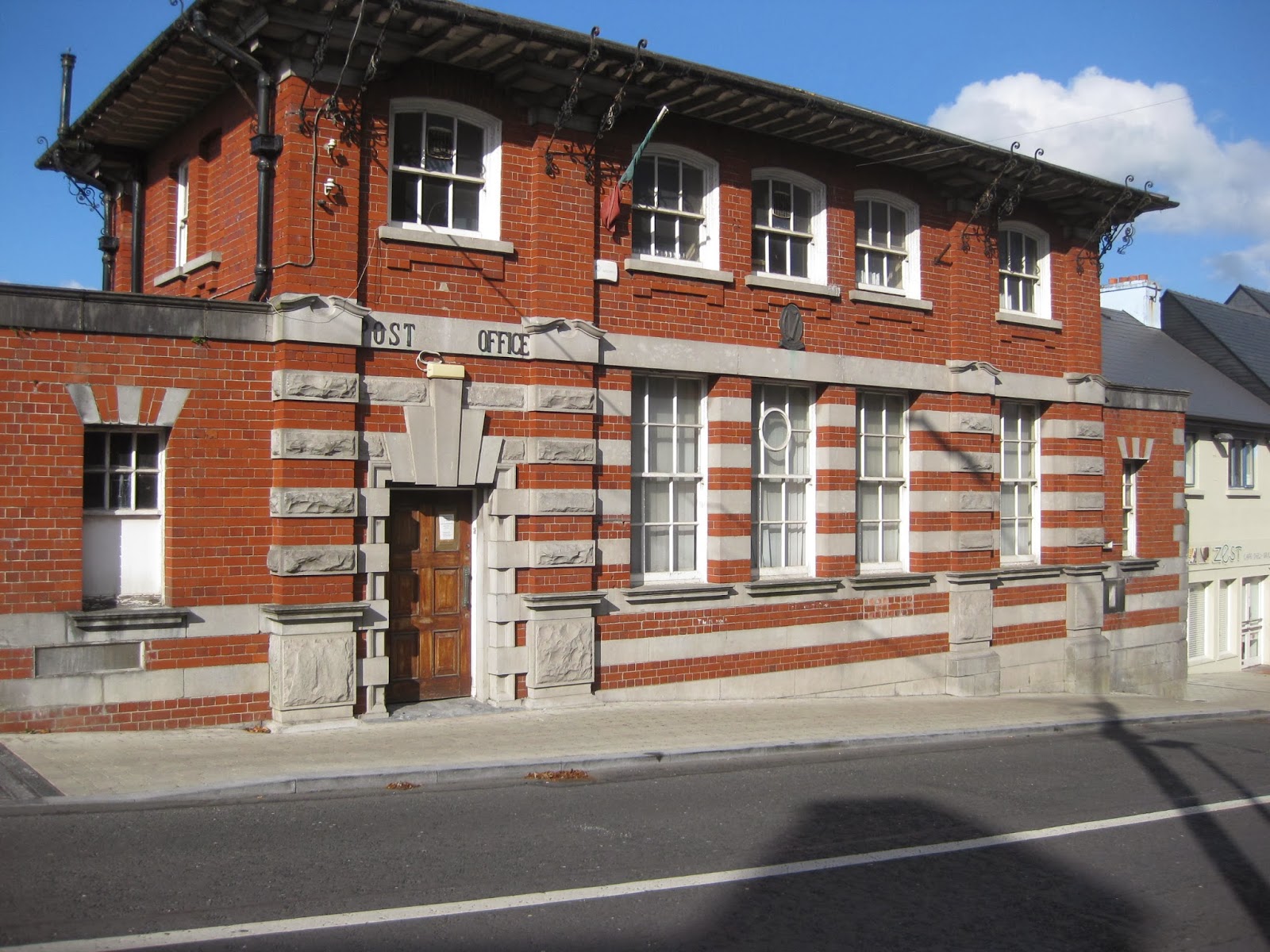
We found a post office in Castlebar that was situated on a bit of a hill and figured it had to be the right one, since it was an older brick building, not one of the newer green buildings that house so many of Ireland's post offices. We took a picture. It was closed, because it was a holiday. Then I think we left.

This time, I tried to do a bit more research before arriving. I knew that the family had lived in Ireland from about 1900 to 1902, and had by all indications not been enumerated in the 1901 Census. When JJ's brother Patrick was born, their address was given as Castle St., in Castlebar. I contacted the Castlebar branch of the Mayo Public Library and asked whether they could provide any information via e-mail. (Our itinerary unfortunately had us in the city only on Sunday and Monday, days when the library was closed.) After I provided what little I knew about my ancestors' years in Castlebar, the library staff was able to send me two articles from the Connaught Telegraph that mentioned my 2x great-grandfather, John O'Hara. (His name is given as O'Hora in both, as well as in Patrick's birth announcement.) One lists John among business owners who applied for a liquor license and were all denied, due to the official's temperance sympathies. The other, included below, was published several years after the O'Hara family returned to the US and announced the sale of their property in Castlebar. The Baltic Street address given confirms that it's the right family, as the O'Haras lived on Baltic Street in Brooklyn for many years.

30 March 1907 Connaught Telegraph
When we got to Castlebar, we soon found ourselves driving past the same post office I'd seen years ago. Practically the next thing I saw was the sign for Castle Street, which was only a couple of blocks below the post office, just down the hill. For once, everything fit the story: the post office was in the right place, it was properly situated on a hill, Castle St. was at the bottom of the hill, etc. It was perfect!

Old Castlebar Post Office

Me, at Castle St.

Looking down Castle St.

I had hoped to mail our postcards from the same post office where my great-grandfather had mailed his letter, but it's no longer an operating post office. There was a sign on the door directing patrons to the new location. Instead, we dropped the cards in a mailbox. None of my research had allowed me to pinpoint the street address of the O'Hara's home and store on Castle St., so I wasn't able to get a picture of the building itself. Still, the street is only 2 blocks long, so I know I couldn't have been far away, and was walking the very same streets that Grandpa JJ did as a young boy. JJ was one of my two great-grandparents to live long enough to meet me, and I have memories of him and Grandma Molly from when I was a very little girl. Some of our other stops began to feel a bit academic in comparison to tracing the footsteps of someone I had known and loved.

Monday, November 4, 2013

A Visit to Pallasgreen, Co. Limerick

After Kells, the next of my ancestral hometowns that we visited on our trip to Ireland was Pallasgreen, Co. Limerick, where the Mulcahys were from. My 2x great-grandfather Michael Mulcahy had emigrated from Pallasgreen, likely in the 1880s, and he had returned for a visit with two of his sons, including my great-grandfather Joseph Mulcahy, in 1905. As a result, we have a somewhat closer connection to Pallasgreen than to Kells - I grew up knowing that my family came from Pallasgreen, but had to do the research to learn that we also came from Kells.

I had visited Pallasgreen once before, when I visited Ireland as an adolescent with my parents. We had been told that our family's old home was "the first house outside of town, on the road with the school." When asking for directions, we had this exchange with a local:
Dad: We're looking for the house where the Mulcahys lived. We were told it was the first house outside of town, on the road with the school."
Local: I know the house you're talking about, but there's no school on that road.
Dad: Can you tell us how you get there?
Local: Just stay straight on this road until you pass the school, and it will be on your left.
During our brief stop (in 1998), we had a bite to eat at the local pub; stopped by what we thought was the old Mulcahy house, though we were a bit unclear on that (no one was home); and my dad talked for a few minutes with the local town historian, who was since passed away. He brought my sister along for that conversation, and I kick myself regularly for not having joined them. I wouldn't have taken notes or anything, at that age, but I might have remembered something. I was at an age, however, when the embarrassment of knocking on a stranger's door and introducing ourselves far outweighed my interest in hearing what said stranger might have to say. That local historian has since passed away.

This time, the town seemed somewhat larger and more developed than I had remembered it, but I don't know if that was perception or reality. My husband Ben and I stopped and had lunch in the local pub, where I took a picture of an old handbill hanging framed on the wall, advertising 1869's fairs and pig markets. 

Before we left, I asked at the bar where we could find the graveyard where I'd been told the Mulcahys were buried - the graveyard "with the old church." They sent me down the road to the Old Pallas Cemetery. I'm pretty sure that on the way we would have passed the house where my family had lived, but I didn't recognize it from either our first visit or the photo I'd seen. It certainly was no longer the first house outside of town - a couple of new developments seemed to have sprung up just outside the main area of town. I already had a picture of the Mulcahy headstone, but I wanted to visit in person and look around the graveyard some more, and I was glad I did.

I'd been warned that this area of Ireland was overrun with Ryans - Michael Mulcahy's mother was a Ryan - or I might have been more excited when we entered the cemetery and noticed that every 2nd or 3rd stone seemed to have the name Ryan on it. I found the Mulcahy gravestone relatively quickly - it helped that I'd already seen a photo of it.
Mulcahy headstone, Old Pallas Graveyard, Co. Limerick

Mulcahy headstone, Old Pallas Graveyard, Co. Limerick

The people listed are my 3x great-grandfather James Mulcahy; his wife Margaret Ryan Mulcahy; two of their children, Ellen Mulcahy O'Brien and Johanna Mulcahy; Ellen's husband William O'Brien; their daughter Margaret O'Brien McMahon; and Margaret's husband Michael McMahon.

Then I looked around at the nearby stones to see if any of them might be related, and while I haven't had a chance to investigate what I found yet, there were several that looked promising. The nearest stone memorialized an Ellen Dwyer, which happens to be the name of one of the sponsors at my 2x great-grandfather's 1860 baptism. Nearby was another Dwyer stone. The next closest stone belonged to an Ellen Ryan. Although Ryans are everywhere, this one seemed significant both for its proximity to the Mulcahy plot and the names of the couple. Margaret Ryan Mulcahy had among her children both an Ellen and a Michael, and this stone was erected by a Michael Ryan to his wife Ellen, who appear to be of an age to have been in Margaret's parents' generation. Neither of these stones was particularly legible, and the photographs don't reveal the inscriptions at all, so I transcribed them to the best of my ability.
Tombstone of Ellen Dwyer, Old Pallas Graveyard, Co. Limerick
Of your charity
Pray for the soul of 
Ellen Dwyer
Who died on the 22 Dec 1865
Aged 47 years
Deeply regretted by her husband
Wm Dwyer Cobelish Pallasgrean
Who erected this as his affectionate
memorial
Headstone of Ellen Ryan, Old Pallas Graveyard, Co. Limerick
Erected
by
Michael Ryan
of Kilduff in mem of his
Beloved wife Ellen
RYAN alias HAYES who
Departed this life June
20th 1845 aged 51 years

After we left the graveyard, we drove into the nearby village of Nicker to visit the church where Micahel Mulcahy would have been baptized. It was beautiful inside, but I only got a picture of the exterior. However, I made a note of the plaque mentioning the church's builder and its history, which confirmed that this was the church building that was around in the Mulcahys' day:
Very Rev. Thomas O'Mahony
P.P. 1812-1849
Built this church in 1820
Died 4th Nov. 1849 and
is buried here
R.I.P.
Nicker Church, Pallasgreen, Co. Limerick

Monday, October 28, 2013

A Visit to Kells, Co. Meath

My husband and I just returned from a trip to Ireland. We aimed to visit all of our ancestral hometowns, though we fell a bit short. There were too many things to see, too little time, and no street signs in Dublin. (The hours we spent driving in circles or many miles in the wrong direction knocked at least one destination off of our itinerary.)

We met some cousins, and tried to take lots of pictures of the places we did visit, so I'm going to devote a post to each hometown we visited. This one is for Kells, Co. Meath.

My Mulvan(e)y and Rothwell families are from Kells. James Mulvany married Bridget Rothwell and John Mulvany married Ann Rothwell in Kells, Co. Meath in 1850 and 1851, respectively. I still have not nailed down who any of their parents were, or whether/how the two Mulvanys and two Rothwells were related to each other. I wasn't there to do research - I mostly just wanted to see the town, get a feel for it. I thought I might ask around to see if there were anywhere that a historically-minded visitor might like to see, or try to find the graveyard and take pictures of any Mulvany or Rothwell stones - even though I didn't know what first names I was looking for.

It was a Sunday afternoon when we arrived, so the entire town was dead. There was almost nothing open, and people were scarce. However, we took these pictures:

We missed the "Welcome to Kells" street sign, but got a picture of this in the window of the local bookstore.

Town of Kells
Town of Kells
We did visit the ancient monastic enclosure and the Kells Round Tower, and looked around the cemetery on the off-chance that we'd run across some Mulvany or Rothwell headstones. Their dates ranged from the 1700s to the much more recent. We didn't notice until we left graveyard that the church - and thus probably the cemetery - was Church of Ireland. My people were Catholics. 

On the way to the round tower and St. Columba's Church.
Kells Round Tower
Gravestones

Ben neglected to tell me that it had stopped raining.

Monday, October 21, 2013

Top 10 Halloween Costumes for Genealogists

It's that time of year, when the air is crisp, the leaves are turning colors, and genealogists and family historians all over America are trying to figure out what to be for Halloween. To aid in your search, I've prepared a list of the Top 10 Halloween Costumes for Genealogists.


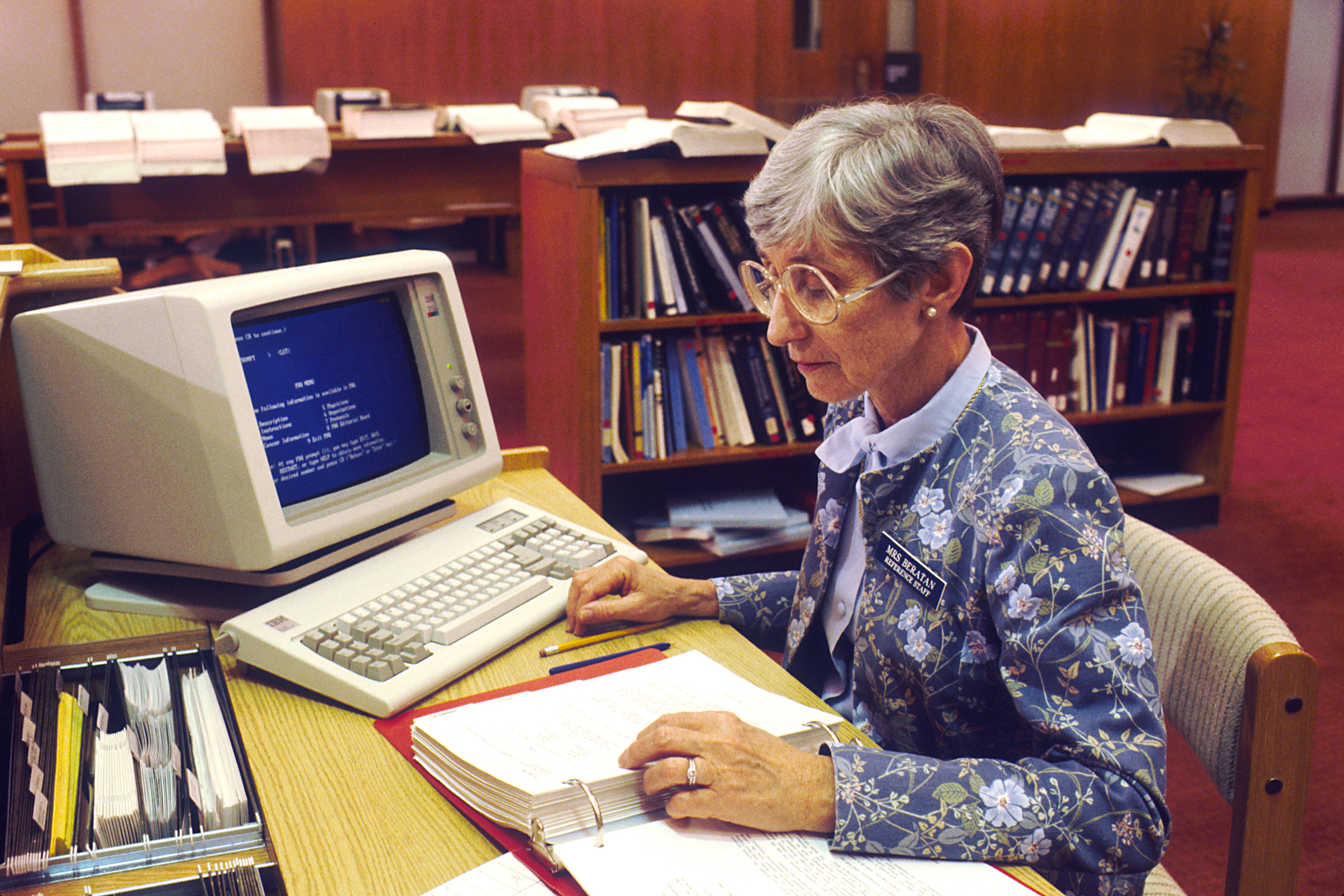
10. A Sexy Librarian

9. One of the other librarians


http://upload.wikimedia.org/wikipedia/commons/6/67/Librarian_accessing_pdq.jpg
Photograph by Bill Branson, National Cancer Institute. Courtesy of Wikimedia Commons.


8. Couples Costume Idea: Your 300x great-grandparents, Adam and Eve (according to that tree you found on Ancestry, at least).


7. The Grim Reaper . . . being interrogated as to when, exactly, it was that he came for Great-Uncle Morty.
http://upload.wikimedia.org/wikipedia/commons/a/ad/Grim_Reaper%2C_Greenwich_Village_%286451246913%29.jpg
Photo by InSapphoWeTrust

6. Professional (or amateur) Genealogist - Just be yourself, while carrying a copy of Evidence Explained, a folder of family group sheets, and a portable scanner, wearing sneakers and jeans to facilitate hiking through cemeteries. 

5. A tombstone that records date and place of death and birth, relationships between the people therein interred, and an epitaph giving great insight into the life and personality of the deceased.

(I'm not entirely sure you'll be able to buy a ready-made costume with the inscription described above.)


4. Your family tree
(Just add more branches!)


3. Coat of Arms - This homemade costume is created by cutting the sleeves of of several old long-sleeved shirts and sewing them to the jacket you're wearing. Attach inflated rubber gloves to the cuffs of the sleeves, and you have a coat of arms!

2. Your favorite ancestor
One of mine

1. The black sheep of the family.

You may have to dye it black yourself; the only black sheep costumes I could find images of made the Sexy Librarian look like Mother Theresa.


Disclosure: This post contains Amazon.com affiliate links (including many of the photographs). This means that if you choose to make a purchase from Amazon after clicking one of these links, I will receive a small portion of your purchase price as a commission. I personally make a point of starting my Amazon shopping through the affiliate links of bloggers and friends whenever possible, so that large corporations are not the only beneficiaries of my purchases, and I encourage others to do the same, regardless of whether they use my affiliate links or another blogger's.

Monday, October 14, 2013

History Hijinx

As it happens, I have always had an interest in history, cool old stuff, historic mysteries, and house history. It just hasn't always manifested itself quite as productively as it does now.

When I was about 9 or 10, my parents renovated the kitchen in our house. This led to us spending some time with a kitchen that led my cousin Matt, then 3 years old, to walk into the room at a party and announce, "Hey Aunt Laurie! You got no walls!"

I'm not sure exactly what my inspiration was, but at some point I decided that it would be funny to take advantage of this situation to play a trick on the contractor who was doing the work on our kitchen. I wrote a note, crumpled it up, and spent a few days soaking it in tea or coffee and aging it in the sun. Then I folded it up and hid it in the wall before the contractor was going to close the walls. The note was dated to 1931, the year the house was built, and, using my best formal and old-fashioned 9-year-old vocabulary, said something along the lines of

To whom it may concern:

Be it known that this is an important and historic house and should always be preserved undisturbed. Ensure that no one damages or changes this important building. By the time you have reached this note, you have already done irreparable damage to this valuable building.

Sincerely,
[Man who built the house]*

(Note to 9-year-old me: buildings are not generally referred to as "historic" the same year they're built.)

I sat back and waited for the contractor to find the note and be horrified that we had made changes to this important historic building! It never happened. I'm sure they just put up the sheet rock without digging around too much behind the studs. (This is about what you'd expect, given my track record of successful pranks as a kid (or an adult, for that matter.)) My note is still behind the wall, if it hasn't disintegrated already, probably attracting bugs with its remnants of coffee and tea. Should some other homeowner ever try to renovate the kitchen in that house, I am confident that they will not fall for my little joke . . . but I'm not exactly sure what they'll make of it, either!


*I can't think of his name at the moment, but I knew it at the time and may be able to look it up next time I'm home.

Monday, October 7, 2013

Online Spotlight: Young & Savvy Genealogists

I don't do this often, but I'm taking a moment to stop and highlight a new blog - and online community - that I expect will do great things. Young & Savvy Genealogists focuses on connecting and highlighting the stories of those in the research community who are under the age of 30.

This is great! I've often thought that we needed a place online to do this exactly. Young genealogists are not exactly such rare birds as is sometimes supposed, but the stereotype persists. As is so often the case, the stereotype is damaging to everyone concerned. Genealogists in general are perceived as old, stodgy, and behind-the-times. (Untrue of most genealogists I know, regardless of age!) Young genealogists are sometimes thought of by other family historians as neophytes and inexperienced researchers who don't contribute to the larger community. (Also largely untrue!) Their non-genealogy peers just think they're nuts. (Potentially true.)

In reality, of course, genealogists of all ages - particularly those in the online community - are frequently tech-savvy early adopters. (I'm not, but I'm not representative of either my hobby or my generation.) Genealogists of all ages are - or should be - excellent researchers. The ones who aren't aren't limited by their age. Personally, I found that entering the world of family history research and writing directly from the world of academic research and writing in college meant that my research skills were at their peak.

In other words, young genealogists are really no different from the field at large. And yet, they - we - have some particular advantages and unique challenges that are addressed infrequently in the larger community. The best way to encourage the participation and leadership of the younger generation is to have a space where they can meet people like themselves, address the unique issues of their youth, and share their own stories. Young & Savvy Genealogists is a new endeavor, but I hope that between the blog and the Google+ Community, it can become a place where young researchers can come together - from newbies to regular guys (like me) to experts and leaders in the field - and discuss the issues that bring them together and the traits that they share.

If you're under 30, definitely check it out!