Even though I've been far too busy for genealogy lately (there's not much time for genealogy when you're finishing grad school, planning a wedding, and hunting for a job!) I had the good fortune to be contacted, separately, by a couple different Mulvaney family researchers. I benefitted greatly from their research, and gave them everything I knew, even though I haven't had time to put much new effort in lately. Then I put them in touch with each other.
As a result, I have some new material to post - for which I can't claim any credit - from the Mulvaney side of the family. Sometimes, genealogy finds you!
This is, we believe, the death certificate of Bridget Rothwell Mulvaney. She died on 8 February 1883, in her 50s; the age given reads either 53, 55, or 58. The age she most often gave in census years corresponds with a birthdate of around 1832, which would put her at 51 in 1883. She's female, white, and married, which means that her husband James must have died after 1883. I've been unable to find him in the 1892 NYS Census or the 1900 Federal Census, so I should probably be looking for his death between 1883 and 1892. She's Irish-born and has been in the US for what appears to read "30" years. (That corresponds with immigration around 1853, which is feasible, as their oldest son, Thomas, was US-born around 1855. (However, I just reminded myself, there was possibly an older child, a girl named Mary Ann, who was baptized in NY in 1852, and seems to have died before 1860.)) She has lived in NYC those entire 30 years. Both of her parents were Irish-born, unsurprisingly. Her place of death was 135 King St., Ward 12, Brooklyn. The only address we ever had for the Mulvaneys was 194 King Street, which is mere blocks away. Had they moved? Or was one of her children living nearby, and she died at his house? If the latter, she'd probably been there for some time. We see from the remainder of the certificate that she'd been ill - with paralysis and asthemia - for 4 months before she died, since October 7, 1882.
More later on where Bridget went next!
Friday, July 23, 2010
Wednesday, July 21, 2010
Baby Pictures
My cousin John just sent me this picture of my great-grandfather, Joseph Mulcahy, and his younger brother Michael.
Joseph is on the left, slightly older and with the adorable curls (so that is where my sister Anna gets her curly hair!) - and is that a riding crop he's holding?! Joseph was born 3 September 1896, and Michael was born 11 March 1899, so I'm guessing this picture was taken in late 1899, maybe right around when Joseph turned 3.
Joseph and Michael were the 4th and 5th in a family that, at the time, included 5 children. I'm not sure where their older siblings are in this photo - in 1899, Margaret would have been about 9, James 7, and Matthew 6. The picture includes only the babies of the family.
What's most interesting to me is that Papa's face really seems never to have changed. Even at the age of 3, you can see the very strong resemblance to his pictures as an adult. (Examples here and here.)
Joseph is on the left, slightly older and with the adorable curls (so that is where my sister Anna gets her curly hair!) - and is that a riding crop he's holding?! Joseph was born 3 September 1896, and Michael was born 11 March 1899, so I'm guessing this picture was taken in late 1899, maybe right around when Joseph turned 3.
Joseph and Michael were the 4th and 5th in a family that, at the time, included 5 children. I'm not sure where their older siblings are in this photo - in 1899, Margaret would have been about 9, James 7, and Matthew 6. The picture includes only the babies of the family.
What's most interesting to me is that Papa's face really seems never to have changed. Even at the age of 3, you can see the very strong resemblance to his pictures as an adult. (Examples here and here.)
Thursday, June 10, 2010
Genealogical Intuition - Can You Trust Your Gut?
The blessing and the bane of the family historian's toolkit. Intuition. That feeling. Just knowing. It's happened to me twice in the past couple weeks, and while it was kind of exciting ("That's what I thought! I knew I was right!"), it was also a little disconcerting. I knew I was right? No. Now I know I was right. Before, I just thought I was right.
Genealogists spend a lot of time talking about standards of evidence. And yet, it's so hard to ignore that feeling that keeps pulling you towards that one particular record when you have no indication that the individual in that record is any more likely to be the ancestor you're searching for than any of the other people who have (or don't have) his name.
1) I explained recently how I'd been drawn to a particular John O'Hara in Ancestry.com's Index to Petitions for Naturalization filed in New York City, 1792-1989. And it seems I was right! Now, I wouldn't have used an extracted index to add information to a database or family tree. But some of us grad students without full time jobs live in genealogical poverty and don't have the freedom to send away for - and pay for - records we aren't sure pertain to our research. Given that every incorrect record I order is one correct record I can't afford, would I have been justified in paying for that record just because I thought it was the right one? (Remember, nothing in the record gave me any reason to think it was the right one. I just had a feeling.)
2) I was recently looking for my fiance's relatives in the 1901 Irish Census online. We knew that his great-grandmother's name was Bridget Theresa Healy, and that she was variously recorded as Bridget, Theresa, and Tess. Between census records, vital records, and a family diary, information indicated that she was "of Waterville, County Kerry, Ireland," her parents were James Healey and Bridget Sullivan, she was born around 1884 and immigrated around 1904. So she should have been in Ireland in 1901. But we couldn't find her! (Because she developed tuberculosis and spent time in a sanatarium before dying young, she's identifiable on few US Censuses, and her daughter, Ben's grandmother, knew little about her.) Ben was unconvinced by the widowed Bridget Healy, a woman old enough to have been Bridget Sullivan Healy, who was living with several of her kids - no Bridget Theresa - near but not in Waterville, but I had a feeling. He preferred a couple of other Bridget Healys, of Bridget Theresa's age, who didn't match certain other details. I had no particular reason to think I was right - there were several Healy families in the Waterville area, some of whom had daughters of the proper age but parents with the wrong names, or vice versa - and literally the only thing we knew about the Healys was that Bridget Sullivan Healy had to be old enough to have borne a child in the mid-1880s. It's pretty easy to fall into the right age range when that range is 40 years wide. We didn't have a lot to go by.
Should I, or should I not, have insisted on taking the Waterville family most seriously? I certainly wanted to. I was so sure, but without any evidence.
Eventually, we discovered the Church Records Project at the Irish Genealogy website. We were able to find extracted baptismal records for Bridget Theresa Healy and several other children of James Healy and Bridget Sullivan. From there, I could match up the names and ages of the other children born to the couple to the children still living at home with Bridget in 1901. Ben doesn't like it when I point out that I'm right, but in this case, well, I wasn't wrong.
Can genealogical intuition be a useful tool? Or is it glorified guessing that can lead you down dangerously wrong paths with false confidence?
Genealogists spend a lot of time talking about standards of evidence. And yet, it's so hard to ignore that feeling that keeps pulling you towards that one particular record when you have no indication that the individual in that record is any more likely to be the ancestor you're searching for than any of the other people who have (or don't have) his name.
1) I explained recently how I'd been drawn to a particular John O'Hara in Ancestry.com's Index to Petitions for Naturalization filed in New York City, 1792-1989. And it seems I was right! Now, I wouldn't have used an extracted index to add information to a database or family tree. But some of us grad students without full time jobs live in genealogical poverty and don't have the freedom to send away for - and pay for - records we aren't sure pertain to our research. Given that every incorrect record I order is one correct record I can't afford, would I have been justified in paying for that record just because I thought it was the right one? (Remember, nothing in the record gave me any reason to think it was the right one. I just had a feeling.)
2) I was recently looking for my fiance's relatives in the 1901 Irish Census online. We knew that his great-grandmother's name was Bridget Theresa Healy, and that she was variously recorded as Bridget, Theresa, and Tess. Between census records, vital records, and a family diary, information indicated that she was "of Waterville, County Kerry, Ireland," her parents were James Healey and Bridget Sullivan, she was born around 1884 and immigrated around 1904. So she should have been in Ireland in 1901. But we couldn't find her! (Because she developed tuberculosis and spent time in a sanatarium before dying young, she's identifiable on few US Censuses, and her daughter, Ben's grandmother, knew little about her.) Ben was unconvinced by the widowed Bridget Healy, a woman old enough to have been Bridget Sullivan Healy, who was living with several of her kids - no Bridget Theresa - near but not in Waterville, but I had a feeling. He preferred a couple of other Bridget Healys, of Bridget Theresa's age, who didn't match certain other details. I had no particular reason to think I was right - there were several Healy families in the Waterville area, some of whom had daughters of the proper age but parents with the wrong names, or vice versa - and literally the only thing we knew about the Healys was that Bridget Sullivan Healy had to be old enough to have borne a child in the mid-1880s. It's pretty easy to fall into the right age range when that range is 40 years wide. We didn't have a lot to go by.
Should I, or should I not, have insisted on taking the Waterville family most seriously? I certainly wanted to. I was so sure, but without any evidence.
Eventually, we discovered the Church Records Project at the Irish Genealogy website. We were able to find extracted baptismal records for Bridget Theresa Healy and several other children of James Healy and Bridget Sullivan. From there, I could match up the names and ages of the other children born to the couple to the children still living at home with Bridget in 1901. Ben doesn't like it when I point out that I'm right, but in this case, well, I wasn't wrong.
Can genealogical intuition be a useful tool? Or is it glorified guessing that can lead you down dangerously wrong paths with false confidence?
Wednesday, June 9, 2010
This American Life: Conventions
Today at work, I was listening to an episode of This American Life. While it's not at all related to genealogy, I thought the episode, Conventions, might be interesting to those of you geneabloggers and others who will be at the SCGS Jamboree this weekend! You can download it on iTunes for $0.99 or stream it online for free at thisamericanlife.org. It might make for some fun listening as you travel to the Jamboree this weekend, and it sure made me wish I'd be joining you!
Friday, June 4, 2010
Genetic Genealogy
I love finding genealogy in unexpected places. On one of the non-genealogy blogs I often read, I found this story last week. From Conversion Diary:
I hesitate to call it a "cool" story - because of the unfortunate genetic propensity to colon cancer in her family - but I think it's amazing that the researchers were able to determine exactly where that mutation first occurred, and in whom it first occurred, not to mention the relationships of all the people he passed it on to! As a family historian, though, I just think it's a shame that the descendancy chart she saw had names omitted!
A few years ago my family was asked to participate in a study ofHNPCC, a genetic mutation that causes colon cancer. My dad's family is known to carry it, so some researchers who combine genetics with genealogy wanted to get info from us to find out more about how this mutation has spread. Thorough the study we found out that my dad has it (hence his colon cancer 25 years ago); I had a 50/50 chance of inheriting it, but I didn't get it (whew!).
What I found most interesting was the fact that they've traced all cases of HNPCC back to one man who came to America from Hesse, Germany in the early 1700's. All of us who have or have parents who have the HNPCC mutation are related to one another. I've seen the researcher's chart (names omitted) that shows all these thousands of people spread out all over the country, all going back to this one guy. I found that fascinating.
I hesitate to call it a "cool" story - because of the unfortunate genetic propensity to colon cancer in her family - but I think it's amazing that the researchers were able to determine exactly where that mutation first occurred, and in whom it first occurred, not to mention the relationships of all the people he passed it on to! As a family historian, though, I just think it's a shame that the descendancy chart she saw had names omitted!
Thursday, June 3, 2010
Does that say what I think it says?!
There was a while when I was searching for the passenger manifest showing my great-grandfather, John O'Hara, returning to the US as a child after his family had spent a few years in Ireland. There were a couple of possible John O'Haras in the right time period, but I wasn't ever sure just which one was him. The most likely one showed up on the passenger manifest all by his lonesome, 4 years old, without any parents or younger brothers listed nearby, though it was noted that he was "going with father + mother." I thought I'd looked through all the pages of that manifest to find his father (and the rest of his family?) but either I meant to but didn't, or I missed them when I did. When it finally occurred to me that I should be searching on his brother Eugene's name instead, I got a hit, for Eugene, on the same ship, which sailed in 1902. The family of 5 is listed on 3 different pages.
Eugene and Patrick are on the first page of the manifest, almost obscured by damage:
As I said, Grandpa JJ is all on his own page:
And their parents, John and Mary, are on yet another page:
Now, it was months ago that I found these records, but it wasn't until last night - I wanted to look at their "place of last residence" to see if I could find them in the 1901 Irish Census - that I looked particularly closely at just what this manifest said. Next to John Sr.'s name, it says in big letters that he's a US Citizen. Written directly underneath that, though (and I mean underneath it, like the handwriting overlaps, not underneath it like on the next line), it says when he became a citizen!
I can't necessarily read the whole thing, but it says something like "Cit. paper of #29 something something Kings Co., NY, Oct 14/98."
Wait, for real? All this time, the exact date of John O'Hara's naturalization had been sitting right there in my files and I hadn't noticed it? I'd been looking at naturalization indexes this week, and, as per usual, the number of John O'Haras who had naturalized in NYC between the late 1880s and 1900 was staggering. (I can't even imagine how people research Smiths, when I have so much trouble with O'Haras!) There was one that seemed particularly likely, but I couldn't be sure and didn't know if I wanted to take the chance on ordering it. This morning, I searched on Ancestry for John O'Hara naturalized in 1898, and lo and behold, that John O'Hara that I'd been tempted by? That John O'Hara was naturalized 14 October 1898!
I think it's safe to say that I'll hesitate no longer!
Eugene and Patrick are on the first page of the manifest, almost obscured by damage:
As I said, Grandpa JJ is all on his own page:
And their parents, John and Mary, are on yet another page:
Now, it was months ago that I found these records, but it wasn't until last night - I wanted to look at their "place of last residence" to see if I could find them in the 1901 Irish Census - that I looked particularly closely at just what this manifest said. Next to John Sr.'s name, it says in big letters that he's a US Citizen. Written directly underneath that, though (and I mean underneath it, like the handwriting overlaps, not underneath it like on the next line), it says when he became a citizen!
I can't necessarily read the whole thing, but it says something like "Cit. paper of #29 something something Kings Co., NY, Oct 14/98."
Wait, for real? All this time, the exact date of John O'Hara's naturalization had been sitting right there in my files and I hadn't noticed it? I'd been looking at naturalization indexes this week, and, as per usual, the number of John O'Haras who had naturalized in NYC between the late 1880s and 1900 was staggering. (I can't even imagine how people research Smiths, when I have so much trouble with O'Haras!) There was one that seemed particularly likely, but I couldn't be sure and didn't know if I wanted to take the chance on ordering it. This morning, I searched on Ancestry for John O'Hara naturalized in 1898, and lo and behold, that John O'Hara that I'd been tempted by? That John O'Hara was naturalized 14 October 1898!
I think it's safe to say that I'll hesitate no longer!
Wednesday, June 2, 2010
1901 Irish Census
The 1901 Irish Census has gone live at the website of the National Archives of Ireland! I know what I'll be doing tonight!
Thursday, May 20, 2010
The Ghost of Bobby Dunbar
This morning I happened upon another episode of This American Life that was all about genealogy! In "The Ghost of Bobby Dunbar,"a woman starts to investigate a family story she grew up with, with very interesting results. It's a really great story, complete with newspaper clippings, court files, finding relatives on the internet, and everything else genealogists enjoy! You see what happens when you're nerdy enough to search "archives" in a radio show's archives? (Wrap your mind around that!) You can download the episode for $0.99 on iTunes, or stream it for free from thisamericanlife.org.
(As a disclaimer, it is a story that demonstrates how genealogy can be "another reason for your family to hate you," which we know, of course, is usually not the case. But when it does happen, it's probably related to stories as cool, as involved, and thus as crucial to relatives' sense of self as this one.)
Monday, May 17, 2010
1905 NYS Census - Loughlin/Renehan
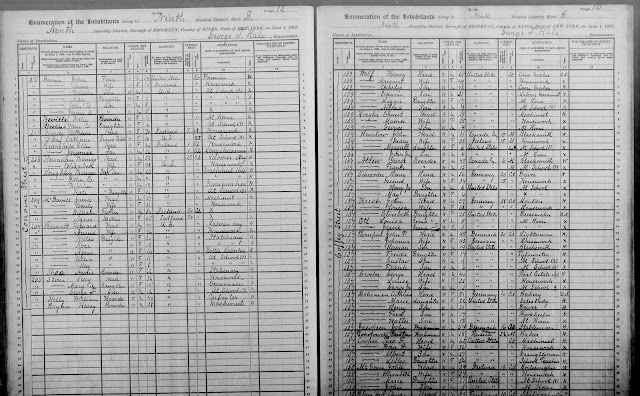
This is the 1905 NYS Census of the Loughlin-Renehan family. Julia Mulvaney's sister Elizabeth Toner Loughlin Renehan lived at 213 Conover St., with her (second) husband, Thomas Renehand and several of her children (from her first marriage), Thomas, John E., William, and Kate Loughlin. Thomas is 52, Elizabeth is 48, Thomas Loughlin is 23, John is 21, William is 19, and Kate is 11. Thomas Renehan is a day laborer, Elizabeth does housework, Thomas and John E. Loughlin are "Machinist Help," and Kate is "at school." I wonder whether Thomas and John E. are "help" for their uncle, Julia's husband Patrick, who was a machinist. (It appears that there were several machinists on their block as well; it wasn't necessarily Patrick they were working with.) There's a 9 in parentheses next to "at school" by Kate's name. When I saw numbers in parentheses on the census return for the Mulvaneys, I assumed they referred to the grade the child was in; the numbers over there matched up to what grades the kids would have been in. There, the 11-year-olds (James and his cousin Thomas) have the number 4 in parentheses. Eleven-year-olds in 4th grade is appropriate, but 11-year-old Kate certainly wasn't in the 9th grade. What do you think these numbers mean?
Sunday, May 16, 2010
Census Taking, History Making
In this census year, I think we're all gaining a little insight into the ways our ancestors were enumerated in prior censuses. The Census Bureau had our 2-apartment building listed as containing 3 residences, so even though my roommates and I sent back our census form weeks ago, we just got a visit from a very nice, but slightly flustered census taker. (She started to fill in our information on the form for the house next door before I corrected her.)
The experience left me wondering what's going to happen when our descendants go looking for us in the 2010 census 72 years from now. I acted as the informant who said that the upstairs apartment was vacant, and they already had our response for our ground floor apartment, but I had to provide the information for my roommates and I all over again because something had to be filled out for the third (non-existent) residence. She included a note that the basement and the ground floor were one apartment, but now that they have our information twice over, what happens?
Are we counted twice? There must be provisions in place to avoid that, considering that getting an accurate count is the whole point of the census.
If they only "count" one return, is it the one we sent in for the ground floor apartment, or the one I just helped her fill out, for the non-existant third residence? I sure hope it's the former, because I am not the most reliable source of information for my two roommates. I couldn't remember the birthday of one of them at all. I was pretty sure it was August, but didn't supply even that information because I wasn't positive. I thought I was positive about the other's birthday, but nope, I was off by two days. Imagine the damage I may have done to some genealogist in the future!
And what if we do get counted twice, or at least if both returns are kept, as they probably will be? We're all familiar with the phenomenon of finding an ancestor twice in two different places in a given year's census, but what happens when you find an ancestor twice in the same place in one year's census? Does the universe implode?
Besides, since my name is listed as the informant for the upstairs apartment, my descendants could one day find me listed on the returns for all 3 of the 2 apartments in this building!
The experience left me wondering what's going to happen when our descendants go looking for us in the 2010 census 72 years from now. I acted as the informant who said that the upstairs apartment was vacant, and they already had our response for our ground floor apartment, but I had to provide the information for my roommates and I all over again because something had to be filled out for the third (non-existent) residence. She included a note that the basement and the ground floor were one apartment, but now that they have our information twice over, what happens?
Are we counted twice? There must be provisions in place to avoid that, considering that getting an accurate count is the whole point of the census.
If they only "count" one return, is it the one we sent in for the ground floor apartment, or the one I just helped her fill out, for the non-existant third residence? I sure hope it's the former, because I am not the most reliable source of information for my two roommates. I couldn't remember the birthday of one of them at all. I was pretty sure it was August, but didn't supply even that information because I wasn't positive. I thought I was positive about the other's birthday, but nope, I was off by two days. Imagine the damage I may have done to some genealogist in the future!
And what if we do get counted twice, or at least if both returns are kept, as they probably will be? We're all familiar with the phenomenon of finding an ancestor twice in two different places in a given year's census, but what happens when you find an ancestor twice in the same place in one year's census? Does the universe implode?
Besides, since my name is listed as the informant for the upstairs apartment, my descendants could one day find me listed on the returns for all 3 of the 2 apartments in this building!
Thursday, May 13, 2010
Treasure Chest Thursday - My Grandmother's Wedding Dress
(Cross-posted at When Hoya Met Saxa)
When I was at home last weekend, I tried on my very first wedding dress, the dress my grandmother wore when she married my grandfather in the 1950s. It's satin with lace, and it was worn by both Grandma and, in the 1980s, my aunt Linda. (The lace isn't original, but was replaced when Linda wore it, and is so yellowed that it would have to be replaced again if I were to wear it.)
I'm going to keep shopping around, doing some of my shopping in relatives' closets and some of it in bridal boutiques. But here's dress #1.
When I was at home last weekend, I tried on my very first wedding dress, the dress my grandmother wore when she married my grandfather in the 1950s. It's satin with lace, and it was worn by both Grandma and, in the 1980s, my aunt Linda. (The lace isn't original, but was replaced when Linda wore it, and is so yellowed that it would have to be replaced again if I were to wear it.)
I'm going to keep shopping around, doing some of my shopping in relatives' closets and some of it in bridal boutiques. But here's dress #1.
Ben, the rest of this post is not for your eyes.
Tuesday, May 11, 2010
"They changed it at Ellis Island": Betty White on SNL
"Blarfengar Blarfegnar" spelled L-E-E S-M-I-T-H. And I thought it was bad when my 2nd great aunt Helen Quinn was enumerated as Hellen Quinne!
Subscribe to:
Posts (Atom)